

Grammarly
Grammarly’s individual Free plan is listed at $0 per month and includes spelling and grammar checking, writing-tone visibility, and 100 AI prompts per month. The company presents these as Free plan features, not as a preview-only offer. Pro is a separate paid plan with additional features, including full-sentence rewrites and detection of plagiarism and AI-generated text. The plans page also displays an offer to try Pro for $0, but does not state its duration, eligibility, or full billing terms. That offer should not be confused with the ongoing Free plan.
This review is based on the published published product, plan, terms, and privacy information, not firsthand testing. Those sources establish what Grammarly says its plans include; they do not confirm how accurate its suggestions or detectors are, how features behave in different apps, or whether outputs can be exported. Where the official site does not answer a practical question, it is treated as unknown rather than assumed.
What Grammarly offers
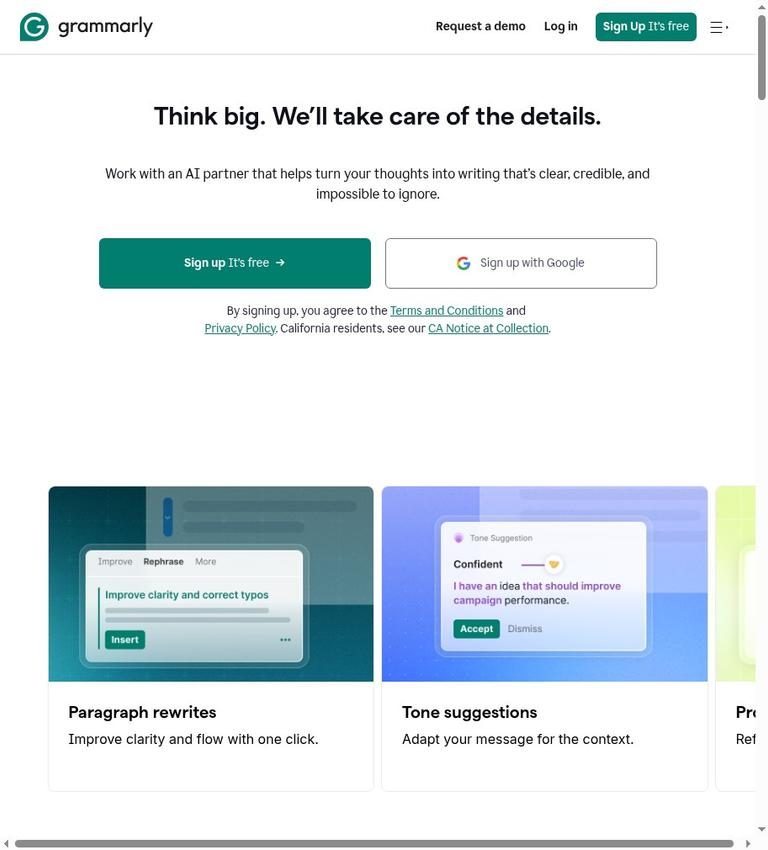
Grammarly describes itself as an AI partner intended to help turn thoughts into clear, credible writing. Its homepage lists proofreading, paragraph rewrites, tone suggestions, a Humanizer agent, and an AI Detector agent. It also lists separate Grammar Checker, Plagiarism Checker, and AI Detector tools. These labels describe different tasks: correcting writing, rewriting text, and attempting to identify plagiarism or AI-generated text are not interchangeable functions.
For a reader comparing plans, the Free-versus-Pro distinction is more useful than a broad list of homepage features. The Free plan lists writing without spelling and grammar mistakes, seeing writing tone, and generating text with 100 AI prompts. Pro lists full-sentence rewrites, tone adjustment, plagiarism and AI-generated-text detection, and 2,000 AI prompts per member per month. A feature appearing on the homepage does not by itself establish that it is included in Free.
Grammarly says its proofreading can refine grammar, structure, clarity, and more. It describes paragraph rewrites as a way to improve clarity and flow with one click, and tone suggestions as a way to adapt a message to context. These are product descriptions, not independent evidence that a suggestion will be right for a particular sentence. Review any proposed change against your intended meaning, especially if a qualification, factual detail, or deliberate tone matters.
The homepage also lists a Humanizer agent, described as giving writing personality. The official site does not give performance data or explain its specific operation. It is therefore possible to describe the advertised purpose, but not to make a stronger claim about the quality or effect of its output.
Free plan: the verified boundary
The individual Free plan is listed at $0 USD per month. The official site identifies three relevant inclusions: spelling and grammar checking, seeing your writing tone, and 100 AI prompts. The plans comparison gives the AI-generation allowance as 100 prompts per month. This is a usable non-paid starting point for the checks and allowance the company lists; the official site does not confirm that every Grammarly feature is available without payment.
In particular, the plans page lists full-sentence rewrites, tone adjustment, and plagiarism and AI-generated-text detection under Pro. It lists 2,000 AI prompts per member per month for Pro. The Free plan’s 100 prompts per month is a limit on the stated AI-generation allowance, not a stated limit on grammar checking. The official sources do not give word-count, document-count, or file-size limits for core grammar checks, so no such limits should be inferred.
The plans page says Pro includes everything in Free, plus additional features. That helps establish the stated relationship between the plans, but does not resolve every access question. The official pages show sign-up, Google sign-up, login, and create-account actions; they do not explicitly say whether every Free feature requires an account. If account requirements matter, confirm them during signup rather than assuming that a listed free plan works without registration.
There is also a “Try Pro for $0 today” offer, alongside an action labeled “Try for $0.00.” The official site does not say how long the offer lasts, who is eligible, or what billing terms follow. Treat it as an offer whose conditions need checking, not as evidence that Pro is permanently free. The durable free boundary supported here is the individual Free plan and its listed features.
Paid plans and prompt allowances
Grammarly lists Pro at $12 per member per month when billed annually, or $30 when billed monthly. The amounts are published prices; the official site does not elaborate on taxes, regional variations, or other checkout conditions. The two billing intervals are materially different, so compare the price and commitment that apply to your intended billing choice rather than treating the annual monthly equivalent as a monthly-billed price.
The Pro feature list includes rewriting full sentences with a click, adjusting writing tone, writing fluently in English, unlimited personalized suggestions, plagiarism and AI-generated-text detection, and 2,000 AI prompts per member per month. “Unlimited personalized suggestions” is the wording of a listed feature. It should not be read as saying that AI prompts are unlimited: the plan comparison separately specifies 2,000 prompts per member per month.
Enterprise is presented as a Contact Sales option. Its listed plan information includes confidential mode and data loss prevention. The plans comparison lists unlimited prompts per member per month for Enterprise. The official site does not provide an Enterprise price, so this review does not estimate one. Nor does the official site establish the exact terms, availability, or operation of those Enterprise features.
The terms distinguish Enterprise-Tier Services from the consumer terms and say that organizations using those services are governed by a separate Customer Business Agreement. An organization should therefore review the business agreement and plan details applicable to its purchase, rather than assuming that the individual plan description or consumer terms provide the complete picture.
Paid subscriptions are described in the terms as automatically renewing for additional periods of the same duration unless canceled or not renewed. Before subscribing, review the current checkout and cancellation information for the specific plan. The official site establishes the general automatic-renewal provision, but does not supply every detail of cancellation procedures or the Pro trial offer.
Rewrites, detection, and how to assess claims
Grammarly’s product pages describe assistance that can range from proofreading to rewriting. The Free plan expressly lists spelling and grammar checking, while Pro lists full-sentence rewrites and tone adjustment. The homepage separately promotes paragraph rewrites. These descriptions are useful for understanding the intended product scope, but they do not confirm that the same rewriting feature is included in every plan or available in every listed app.
A sensible way to evaluate a suggested edit is to compare it with the original: check that the meaning, important details, and intended voice remain intact. This is general editorial caution, not a claim about a measured Grammarly error rate. The official sources do not include independent accuracy results or performance comparisons.
The AI Detector deserves particular care. Grammarly markets an AI Detector agent as a way to spot AI-generated text and areas to revise, and Pro lists detection of AI-generated text. The official site gives no accuracy or performance metrics. A marketing description cannot establish that a detector result is conclusive evidence about authorship. Likewise, the Plagiarism Checker listing and Pro’s plagiarism-detection feature do not confirm what sources are covered or how accurate the results are.
The prompt counts are specific plan limits, but the material does not explain how a prompt is counted, whether unused prompts carry over, or what happens when an allowance is reached. Do not assume rollover or a particular counting method. If your intended use depends on frequent generation, verify those details in current plan information before relying on the allowance.
Apps and account information
The site lists Grammarly for desktop, Windows, and Mac; a browser extension; and versions or listings for Chrome, Safari, Firefox, and Edge. It also lists Grammarly for MS Office, Google Docs, and mobile, including iPhone, iPad, and Android. These are named access options, not a guarantee that every feature is supported in every environment. The official sources do not state system requirements, compatibility by software version, or feature parity across platforms.
Grammarly also lists Docs as a product or use option. The official site does not detail how Docs relates to other listed products or specify its plan boundaries. It is safer to check the relevant product page than to infer that every feature described for Grammarly applies to Docs.
The terms define Services to include mobile and desktop applications and, when applicable, APIs and SDKs. That definition does not confirm public API availability for individual users, available endpoints, quotas, or API pricing. If programmatic access is central to your workflow, seek explicit documentation rather than treating a legal definition as an API offer.
The site provides sign-up, Google sign-up, login, and create-account actions. The terms say they become effective from account sign-up, access to the services, or acceptance of the terms, whichever happens first. The contracting entity named in the terms is Superhuman Platform Inc., formerly Grammarly, Inc.; the homepage says Grammarly is now part of Superhuman. These details are relevant when reviewing the applicable terms, but do not by themselves explain every account or billing arrangement.
Privacy and legal considerations
The homepage says Grammarly does not sell or monetize user content, provide it for advertising purposes, or allow third-party service providers to train their models on user content. The privacy policy says Superhuman makes money from paid product purchases and not by selling or monetizing user content. These are published company statements and should be presented as such; they do not answer every question about how information is handled.
The privacy policy says user content may include text, emails and drafts, screen content, web pages, documents, files, calendars, images, data, and other content the products are allowed to access. It also describes the collection of account information, technical information, and cookie information. The policy’s stated scope includes products offered as Grammarly and Docs, unless another policy applies.
A significant scope distinction applies to organizational use. The privacy policy says it does not apply to information uploaded to or output from products used under the management of a company, organization, educational institution, or other legal entity. If you use Grammarly through work or school, do not assume that the individual-user privacy policy governs that content. Check the policy and agreement applicable to your organization.
The published privacy material includes a “Retention and Security” heading but does not state retention periods or deletion timelines in the excerpt. It is therefore not possible to establish how long particular information is kept from the official site provided here. Users with strict retention or deletion requirements should check the current policy or seek an applicable organizational answer before submitting sensitive material.
The terms say that inputs and resulting outputs from generative AI features are User Content, and that users own all right, title, and interest in User Content. The published excerpt does not confirm all commercial-use rights or restrictions for generated outputs. Ownership language should not be expanded into a claim that every intended use is permitted under every other applicable condition.
The consumer terms include an arbitration agreement requiring most disputes to be resolved by binding and final arbitration, with limited exceptions, and include a class-action and jury-trial waiver. Those provisions can matter when accepting the terms. Read the current legal text for the precise scope and exceptions rather than relying on this summary.
Who may find Grammarly worth considering?
Grammarly is worth investigating if your main need is the spelling and grammar checking listed in Free, and you also value tone visibility or a 100-prompt monthly AI allowance. The published plan boundary is relatively clear for those features. If you need full-sentence rewrites, tone adjustment, or the listed plagiarism and AI-generated-text detection, those are specified under Pro in the official site.
The product’s platform listings may be useful if you want to check whether an option is available for a particular device or writing environment. They do not confirm that features work identically across browser extensions, desktop applications, office software, document tools, and mobile apps. Verify the specific integration and feature availability that matter to you.
It is a less settled choice if your decision depends on detector accuracy, documented plagiarism coverage, exact file formats, export behavior, detailed grammar-checking limits, supported languages, or retention periods. Those points are not established by the official site. Pro’s English-writing feature is listed, but languages beyond that are not specified in the official site. If any of these requirements are essential, check the current documentation before relying on the product.
A related writing-tool listing to investigate is QuillBot. The official site does not support a feature-by-feature comparison, so this is an alternative to research, not a recommendation based on verified claims about its functions, limits, or pricing. Compare the current documentation for both products against your specific needs.
Verdict
Grammarly’s individual Free plan is a genuine non-paid option according to the official site: it lists spelling and grammar checking, tone visibility, and 100 AI prompts per month, and is priced at $0 per month. Pro is listed at $12 per member per month billed annually or $30 when billed monthly. Its stated additions include full-sentence rewrites, tone adjustment, plagiarism and AI-generated-text detection, and 2,000 AI prompts per member per month. Enterprise is a Contact Sales plan, with no published price.
The strongest evidence-based reason to start with Free is that its writing checks and tone visibility are listed as plan features rather than only as a preview. The main cautions are that the “Try Pro for $0” offer lacks stated duration and eligibility, the detection tools have no published accuracy data, and important practical details such as export support and retention timelines remain unknown. Use the plan descriptions as boundaries, review generated or rewritten material yourself, and confirm current terms before relying on a paid offer or submitting sensitive content.


