

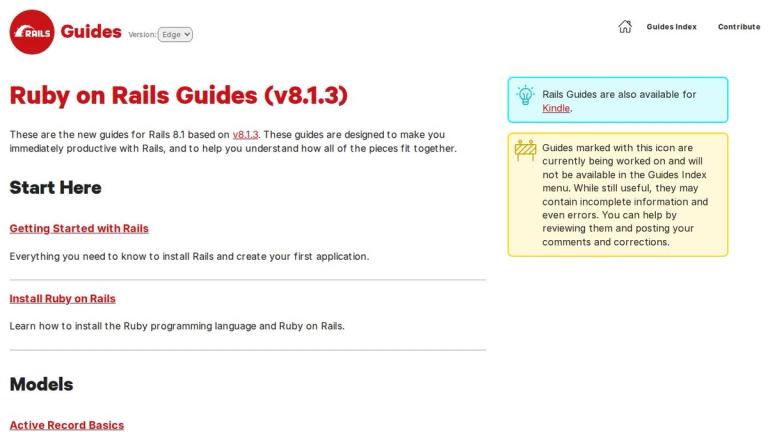
Ruby on Rails Application Templates
Ruby on Rails Application Templates are part of the comprehensive Rails framework ecosystem, providing developers with powerful tools for scaffolding and generating web applications quickly and consistently.
Overview
As documented in the official Ruby on Rails Guides, Rails includes a robust system of generators and templates that automate the creation of application components, models, controllers, views, and entire application structures. These templates follow Rails conventions and best practices, enabling developers to:
- Rapidly prototype new web applications
- Maintain consistency across projects and teams
- Enforce best practices through convention over configuration
- Reduce boilerplate code with intelligent scaffolding
Key Components
The Rails template system works alongside other core Rails components:
- Active Record - Database ORM and migrations
- Action View - Template rendering and helpers
- Action Controller - Request handling and routing
- Active Storage - File uploads and cloud storage
- Action Cable - WebSocket integration
- Active Job - Background job processing
Documentation Resources
The official guides cover everything from basic setup to advanced customization of generators and templates, making it easy for developers at all levels to leverage Rails' powerful code generation capabilities.
Target Audience
Web developers, Ruby developers, full-stack engineers, startups, and development teams building web applications
Key Features
- Application scaffolding and generation
- Custom generator creation
- Convention-based code templates
- Database migration generation
- Model and controller scaffolding
- View template generation
- Test file generation
- Asset pipeline integration
Use Cases
- Rapid web application prototyping
- Enterprise application development
- API-only application scaffolding
- Full-stack web development
- Team development standardization
- Educational and learning projects
- Startup MVP development
Pros
- Follows Rails conventions for consistency
- Reduces development time significantly
- Well-documented with comprehensive guides
- Active open-source community support
- Battle-tested in production environments
- Extensible with custom generators
Cons
- Learning curve for Rails conventions
- Generated code may require customization
- Tied to Ruby ecosystem
Pricing
Free and open-source (MIT License)


