

Suno
What Suno does
Suno is an AI music-generation service for turning ideas or prompts into songs. The company says it can create complete songs, including vocals, lyrics, and production, from a text prompt. It also says users can make an instrumental instead. These are product descriptions, not independently verified performance claims.
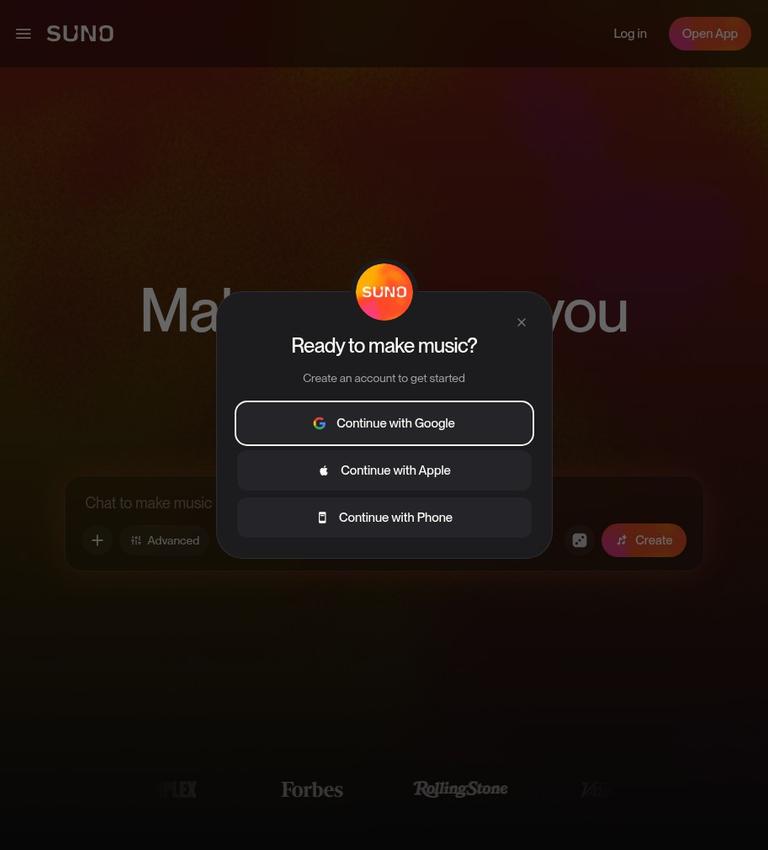
Suno’s site says you can describe a song by genre, mood, or theme, or provide your own lyrics, then create a track. It describes options to regenerate, extend, or refine the result. The homepage also lists controls including Voices, Inspo, exclusions, vocal gender, and sliders for weirdness and style. The official site does not explain every control or establish how consistently each one affects a generation.
The service includes more than prompt-based generation. Suno describes Remix as a way to change a song’s style, rewrite lyrics, or rebuild it around a recording. It says its Voices feature can use a few seconds of your voice to sing material you write, and that users can train custom models on their recordings. Suno Studio is described as a browser-based DAW for arranging, editing, and mixing songs. The site also describes stem separation for carrying time-aligned stems into another DAW, and a library for browsing music by genre, mood, and occasion.
The homepage identifies v6 as its newest model and describes fuller vocals and tighter arrangements. The pricing page also names v6-mini as the best free model and lists v6 and v6-wild as advanced models. The published descriptions do not reconcile these model labels, so check the current plan comparison if model access matters to your decision.
What the workflow involves
The basic workflow described by Suno is to enter a song idea, choose a prompt, and select Create. You can specify genre, mood, or theme, or use your own lyrics. Suno says the service generates a track with vocals, instrumentation, and production, after which you can regenerate, extend, or refine it.
That description does not confirm that a result will match a prompt exactly or meet a particular production brief. Suno lists ways to guide and edit a generation, but the official site does not promise a particular sound, lyric, arrangement, or level of polish. Treat the feature descriptions as available options, not guarantees about the result.
For users bringing in existing material, the free plan lists audio uploads of up to eight minutes. Suno describes Remix as changing a song’s style or lyrics, or rebuilding it around a recording. Its Voices feature is described as using a short recording of your voice to sing written material. These product descriptions do not settle all questions about which plan includes each capability or how a feature will handle a particular recording. Check the plan details before relying on a specific tool.
There are also production-oriented options. Suno describes stem separation as splitting a song into time-aligned stems for use in another DAW. Suno Studio is described as browser-based, for arranging, editing, and mixing. The pricing page lists Suno Studio with MIDI, effects, automation, and design-your-own plugins as a Premier feature; the homepage also lists MIDI export with Premier. The official site does not specify audio download formats, codecs, sample rates, bit depths, or file-size limits.
Free access: what is established
Suno’s pricing page presents its Free plan as $0 per month and “Free forever.” It says the plan includes access to free models, standard features, 50 credits per day, and audio uploads of up to eight minutes. The pricing comparison identifies v6-mini as the best free model. This establishes ongoing free access to song generation, rather than a trial-only offer.
There is a difference between the homepage and pricing page in how the free allowance is described. The homepage FAQ says free users can create up to 10 songs a day without a credit card. The pricing page lists 50 credits per day. The official site does not explain how credits translate into songs or how the two figures relate. Treat them as separate published measures rather than assuming a conversion.
The free plan also has limits that matter if you want to take a finished song elsewhere. The pricing page says Free does not include monthly song downloads or commercial rights. It does not confirm whether a free user can download a preview by another route, or whether a preview can otherwise be used outside Suno. Those questions remain unresolved in the official site; do not assume that generated free songs are downloadable or cleared for external use.
The plan comparison lists a shared creation queue for Free, with four generations at once. Pro and Premier are listed with priority queues and up to 10 at once. Free includes remixing and co-writing with Suno to generate lyrics using its classic model, according to the pricing page. It does not include stem separation or add-on credit purchases. The practical boundary is therefore partly clear and partly unknown: free generation is available, but downloads and commercial rights are not included, and preview use outside the service is not established.
Paid plans, downloads, and rights
The pricing page lists Pro at $10 per month, or $8 per month with annual billing, billed at $96 per year. It lists 2,500 credits and 20 song downloads per month. Pro also includes commercial rights, a priority queue, and stem separation. The plan comparison does not explain how its monthly credit allowance translates into a number of songs.
Premier is listed at $30 per month, or $24 per month with annual billing, billed at $288 per year. The pricing page lists 10,000 credits and 60 song downloads per month, along with a priority queue and commercial rights. The homepage describes Premier as including Suno Studio, a multitrack editor, MIDI export, Persona Voices, and early access to new features. The pricing page describes Studio with MIDI, effects, automation, and design-your-own plugins as a Premier feature.
Some plan descriptions differ across the official pages. The homepage FAQ describes Pro as including 500 songs a month, while the pricing page lists 2,500 credits and 20 song downloads per month. For Premier, the homepage says 2,000 songs a month, while the pricing page lists 10,000 credits and 60 downloads per month. The pages do not explain how these song counts, credits, and download allowances relate. They also use different model descriptions. Check the current plan comparison directly before subscribing, especially if you need to estimate output volume or use a particular model.
Suno says songs created as a paid subscriber are yours to keep and use, giving video background music and album publication as examples. The pricing page marks commercial rights as included with paid plans and directs users to the Terms for limitations. The Terms say Suno assigns qualifying rights it owns in output generated from a paid subscriber’s submissions, subject to the Terms and applicable commercial-use restrictions. They also say commercial exploitation is permitted only for output that complies with the conditions of access and use and that has been obtained through a permitted download under the applicable tier’s download allocation.
These statements establish a distinction between paid and free plans, but they do not amount to a guarantee that copyright will vest in every output or explain every possible licensing issue. The Terms also say output may not be unique and that similar submissions may produce the same or similar output for another user. Read the current Terms and confirm download eligibility before relying on a track for a commercial project.
Accounts, platforms, and privacy
Suno is available through its website and mobile applications; the homepage links to iOS and Android apps. Suno Studio is described as browser-based. The official pages do not confirm a native desktop application or public API. The Terms say that using the site, mobile apps, or another aspect of the service means you agree to the Terms. They prohibit people under 13 from registering, accessing, or using the service.
If you upload a recording or other material, Suno’s Terms say you must have the rights, licenses, consents, permissions, and authority needed to submit and use it, including for generating output or a voice model. That requirement matters when material includes another person’s voice, performance, or other protected content.
Suno’s Privacy Notice says it collects data contained in and associated with content users record or upload, including music, sound, and voice recordings. It also says the service logs creation, upload, download, processing, access, and playback of media and associated results, and that tracking applies across web, mobile, or other service use. Suno says content may constitute or contain personal information depending on its substance and how it is associated with a user or account. Its notice says it does not sell users’ information to third parties.
The Privacy Notice gives a specific retention limit for biometric information: no longer than three years after a user’s last interaction, except as required by applicable law. The official site does not confirm a general retention period for all prompts, uploaded content, outputs, or account data. The Terms also say the service may include a public forum where content can be shared. Review the current privacy notice and settings before uploading sensitive material.
Who may find Suno useful
Suno may suit people who want to turn a musical idea into a generated song, explore styles, or make material to develop further. The free plan gives users an ongoing way to try song generation without paying. People who need monthly song downloads or commercial rights should note that those are not included in Free; the pricing page lists them for paid plans, subject to the Terms and download allocations.
Users who want to work with songs beyond generation may be interested in the described editing, remixing, stem-separation, and Studio features. Match those needs to the current plan comparison before subscribing. The official site does not confirm particular export formats, nor does it guarantee that the generated result will meet a precise creative brief.
Suno may be a poor fit if your decision depends on free commercial use, confirmed free downloads, a specific audio file format, or a clearly reconciled estimate of songs per month. The pages leave those free-preview and plan-count details unresolved. For paid use, the product’s rights statements include conditions and refer users to the Terms. Confirm the current terms, download allowance, and feature availability before making Suno part of a publishing or client workflow.
Verdict
Suno offers prompt-based song generation and describes tools for revising, remixing, and working with audio. Its free plan is presented as ongoing access to generation, with 50 credits per day, but the homepage separately says up to 10 songs a day and the pages do not reconcile those measures. Free does not include monthly song downloads or commercial rights; whether a free preview can be downloaded or used outside the service is not established.
Paid plans add stated download allowances and commercial rights subject to the Terms. Their published song counts, credits, and download limits are not fully reconciled across the published descriptions. Suno is worth considering if you want to explore AI-generated music or need its described production tools, but verify the current plan details, output rights, and download conditions before relying on it for work you intend to publish or deliver.
FAQs
Can you use Suno for free?
Yes. The pricing page lists a Free plan at $0 per month, described as free forever, with 50 credits per day and access to free models. The homepage separately says free users can create up to 10 songs a day without a credit card. The official pages do not explain how those figures relate.
Can you download songs on Suno’s free plan?
The pricing page says Free does not include monthly song downloads. It does not confirm whether a preview can be downloaded through another method, so free-preview downloads remain unclear.
Can you use free Suno songs commercially?
The pricing page says commercial rights are not included with Free, and the Terms limit free-tier output to lawful, personal, non-commercial use. The official site does not confirm that free previews can be used commercially.
What do Suno’s paid plans cost?
The pricing page lists Pro at $10 per month or $8 per month with annual billing, billed at $96 per year. Premier is listed at $30 per month or $24 per month with annual billing, billed at $288 per year. Paid plans auto-renew, can be cancelled at any time, and have taxes calculated at checkout.
What is the difference between Suno Pro and Premier?
The pricing page lists 2,500 credits and 20 song downloads per month for Pro, compared with 10,000 credits and 60 downloads for Premier. Both are listed with priority queues and commercial rights. The homepage lists Studio, a multitrack editor, MIDI export, Persona Voices, and early access among Premier features. The official pages do not reconcile all plan measures.
Can you upload audio or use your voice with Suno?
The Free plan lists audio uploads of up to eight minutes. Suno describes Voices as using a short recording of your voice to sing material you write. Its Terms require you to have the necessary rights and permissions for material you submit, including material used to generate output or a voice model.
Is Suno a desktop app?
Suno is available on its website and through iOS and Android apps. Suno Studio is described as browser-based. The official pages do not confirm a native desktop application or public API.


