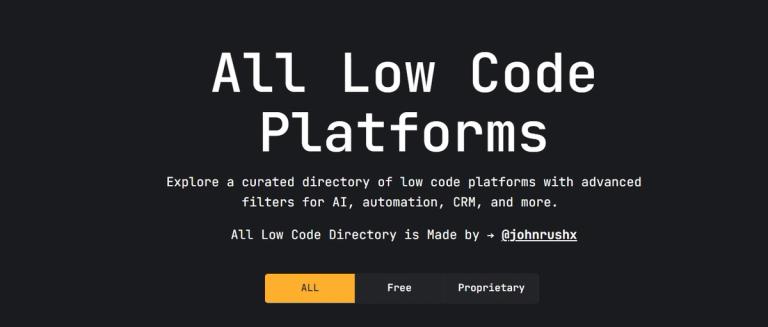
Low Code Platforms Directory brings transparency to the crowded low-code marketplace by presenting clear, curated descriptions of top tools.
Features
- Curated Platform Directory — A hand-picked collection of low-code platforms with clear, concise descriptions. Each listing includes key details like platform type (SaaS, AI, e-commerce), traffic metrics, and a brief overview of what the tool does—helping users quickly assess relevance without wading through marketing fluff.
- Category-Based Browsing — Browse platforms across 30+ specialized categories including AI, automation, CRM, app builders, chatbots, e-commerce, form builders, RPA, and more. This granular taxonomy lets users narrow their search to exactly the type of tool they need, whether it's a workflow automation platform or a website builder.
- Traffic & Popularity Metrics — Each platform listing displays estimated monthly traffic figures (e.g., WordPress at 268.4M, Salesforce at 86.3M, Airtable at 19M), giving users a quick proxy for market adoption, community size, and platform maturity—useful for evaluating reliability and ecosystem strength.
- Platform Submission Feature — Tool creators and founders can submit their own low-code platforms to the directory, ensuring the catalog stays current and comprehensive. This crowdsourced approach keeps the directory fresh with emerging tools alongside established players.
- Advanced Filtering & Search — Users can filter the directory using advanced criteria across multiple dimensions—category, platform type, and use case—making it easy to compare tools side-by-side and find the right fit for specific business or technical requirements.
- Transparent, Unbiased Listings — The directory's stated mission is to bring transparency to the crowded low-code marketplace. Listings are curated rather than paid placements, presenting factual descriptions without promotional bias—helping decision-makers evaluate tools on their actual merits.
Use Cases
Evaluating Low-Code Tools for Enterprise App Development
A CTO or IT director at a mid-size company needs to select a low-code platform for building internal business applications. They browse categories like 'app builders,' 'automation,' and 'platform as a service,' comparing options like Appian, Mendix, QuickBase, and Power Automate Desktop based on traffic data, descriptions, and category fit—streamlining the vendor research process from weeks to hours. Target Audience: CTOs, IT Directors, and Enterprise Architects evaluating low-code solutions for internal application development
Finding the Right Automation & Integration Stack
A startup operations manager wants to automate workflows across their SaaS tools. They explore the 'automation,' 'integration,' and 'robotic process automation' categories to compare platforms like Zapier, n8n, Workato, and UiPath—identifying which tools connect to their existing stack and match their technical skill level. Target Audience: Startup founders, operations managers, and growth teams looking to automate business processes without heavy engineering resources
Discovering Niche & Emerging Low-Code Tools
A product manager at a SaaS company wants to stay ahead of the curve by discovering new low-code tools before they become mainstream. The directory surfaces lesser-known platforms alongside established players—tools like Softr, Back4app, or Flutterflow—giving early adopters a competitive edge in tooling selection. Target Audience: Product managers, tech leads, and innovation teams seeking emerging low-code solutions and staying current with market trends
Marketing & CRM Platform Comparison
A marketing director needs to choose between CRM and customer engagement platforms. They browse the CRM and customer support categories, comparing Salesforce, Creatio, Pipefy, and SurveySparrow based on descriptions, traffic signals, and category alignment—making a more informed decision without vendor sales pressure. Target Audience: Marketing directors, sales operations managers, and RevOps professionals selecting CRM and customer engagement tools
Pros
- Saves significant research time by consolidating 100+ low-code platforms into a single, browsable directory with consistent descriptions—eliminating the need to visit dozens of individual websites.
- Traffic metrics provide a useful proxy for platform maturity and community size, helping users gauge ecosystem strength and long-term viability at a glance.
- Category-based organization across 30+ verticals (AI, automation, CRM, e-commerce, RPA, etc.) makes it easy to find tools tailored to specific business needs rather than generic comparisons.
- Crowdsourced submission model keeps the directory current with emerging tools, ensuring users discover new platforms alongside established market leaders like Salesforce, WordPress, and Zapier.
- Transparent, curated approach without obvious paid placement bias builds trust—users get factual descriptions rather than sales pitches, enabling more objective evaluation.
Cons
- Traffic figures appear to be estimates and may not reflect actual active user counts or platform quality—high traffic doesn't always correlate with the best fit for a specific use case.
- Platform descriptions are brief (typically one sentence), which may not provide enough depth for technical decision-makers who need details on integrations, pricing, scalability, or security features.
- The directory lacks user reviews, ratings, or community feedback—making it harder to assess real-world performance, customer support quality, or common pain points.
- No pricing information or comparison tables are provided, requiring users to visit individual platform websites to evaluate cost—a significant gap for budget-conscious buyers.