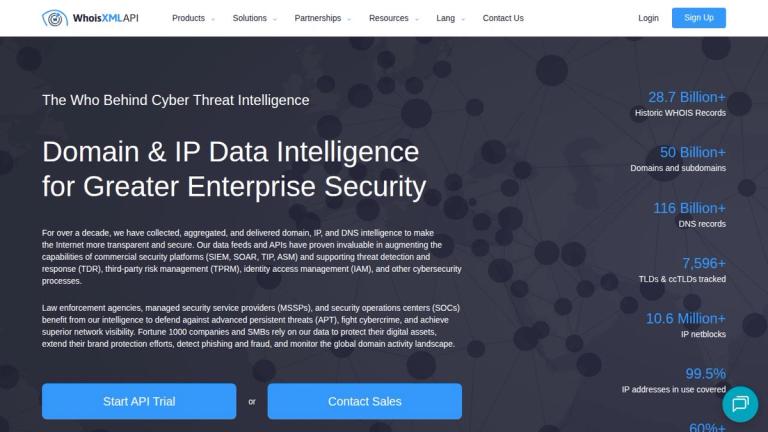
Domain, WHOIS, IP, and DNS data feeds, APIs, and research tools for enterprise security and data-driven business decisions.
Features
- Comprehensive WHOIS & Domain Intelligence — Access complete domain name footprints including current and historical ownership details, registration timelines, status changes, and registrant information across 7,596+ TLDs and ccTLDs. The WHOIS History API provides historical records spanning over 28.7 billion entries, enabling deep investigation into domain ownership evolution and connections between domains, registrants, registrars, and DNS servers.
- Advanced DNS & Passive DNS Intelligence — Leverage the industry's largest passive DNS database with over 116 billion DNS records. The DNS Chronicle API and DNS Lookup API provide current and historical DNS/IP connections across A, MX, NS, and other record types. Monitor suspicious DNS record changes, discover subdomains, and track DNS infrastructure changes over time for comprehensive network visibility.
- IP Geolocation & Network Intelligence — Get detailed context on IP addresses including geolocation, time zone, connected domains, connection type, IP range, ASN, and network ownership details. Covers 10.6 million+ IP netblocks and 99.5% of IP addresses in use. The IP Netblocks API enables mapping of IP ranges to organizations for network attribution and threat correlation.
- Predictive Threat Intelligence Feeds — Subscribe to proactive threat intelligence feeds including Early DGA Detection, Early Warning Phishing, First Watch Malicious Domains, and Typosquatting Data Feeds. These predictive feeds serve as the first line of defense, enabling security teams to identify and block threats before they materialize into attacks.
- AI-Powered Research Tools — Access intelligence through cutting-edge AI interfaces including the MCP Server for LLM integration, Jake AI cloud-based domain intelligence assistant, and a custom ChatGPT Domain Intelligence Advisor. These tools enable conversational investigations and natural language queries against WHOIS, DNS, IP, and threat intelligence data.
- Enterprise Security Platform Integration — Seamlessly integrate with commercial security platforms including SIEM, SOAR, TIP, and ASM systems. The Security Intelligence (SI) Suite and Enterprise API Packages offer complete access to domain, IP, DNS, and subdomain data with predictable annual pricing, supporting threat detection and response (TDR), third-party risk management (TPRM), and identity access management (IAM) workflows.
Use Cases
Cyber Threat Detection & Incident Response
Security operations centers (SOCs) and managed security service providers (MSSPs) use WhoisXML API to enrich threat intelligence, investigate indicators of compromise (IOCs), trace attack infrastructure, and defend against advanced persistent threats (APTs). The APIs enable rapid domain and IP attribution during incident response, connecting malicious domains to their operators through WHOIS history, DNS records, and reverse lookups. Target Audience: Security Operations Centers (SOCs), Managed Security Service Providers (MSSPs), Cybersecurity Teams, Incident Response Analysts
Brand Protection & Digital Risk Management
Enterprises monitor for brand impersonation, typosquatting, and fraudulent domain registrations using Brand Alert API, Typosquatting API, and Domain Availability monitoring. The Registrant Alert API tracks suspicious registration patterns, while WHOIS History helps identify serial infringers. Companies can proactively detect phishing campaigns targeting their customers and take down malicious domains. Target Audience: Brand Protection Teams, Legal Departments, Digital Risk Management Professionals, Fortune 1000 Companies
Law Enforcement Cybercrime Investigation
Law enforcement agencies leverage comprehensive WHOIS history, reverse WHOIS lookups, and domain-to-IP mapping to trace cybercriminals across the Internet. The platform enables investigators to uncover hidden connections between domains, identify infrastructure used for illegal activities, and build evidence chains for prosecution by analyzing historical registration data and DNS patterns. Target Audience: Law Enforcement Agencies, Cybercrime Investigation Units, Digital Forensics Analysts
Third-Party Risk Management & Vendor Assessment
Organizations assess the security posture and legitimacy of third-party vendors, partners, and acquisition targets by analyzing their domain infrastructure, DNS configurations, IP geolocation, and WHOIS data. The Website Categorization API and Domain Reputation API help evaluate risk exposure, while IP intelligence reveals the true infrastructure behind vendor services. Target Audience: Risk Management Teams, Procurement Departments, M&A Due Diligence Teams, Compliance Officers
Pros
- Massive data coverage with 28.7+ billion historic WHOIS records, 116+ billion DNS records, 50+ billion domains and subdomains, and 99.5% IP address coverage—providing the most comprehensive Internet intelligence dataset available in the market.
- Trusted by over 50,000 customers including 60%+ of the Cyber 150, Fortune 1000 companies, and law enforcement agencies worldwide, demonstrating proven reliability and enterprise-grade performance across critical security use cases.
- Comprehensive product ecosystem spanning 30+ specialized APIs, extensive data feeds, web-based research tools, and AI-powered assistants—offering a single vendor solution for all domain, IP, DNS, and threat intelligence needs.
- Over a decade of data collection and aggregation expertise, providing deep historical intelligence that enables longitudinal analysis of domain ownership, DNS changes, and threat actor infrastructure evolution.
- Flexible integration options with support for SIEM, SOAR, TIP, and ASM platforms, plus AI interfaces (MCP Server, Jake AI, ChatGPT integration) that lower the barrier to accessing complex Internet intelligence data.
Cons
- Enterprise-focused pricing structure with annual subscription packages may present budget challenges for small businesses, startups, or individual researchers who need occasional access to premium intelligence data.
- The extensive product suite with 30+ APIs, multiple data feeds, and various tools creates a steep learning curve for new users, requiring significant time investment to understand which products best fit specific use cases.
- WHOIS data accuracy is inherently limited by domain privacy and proxy services (GDPR compliance, registrar privacy protection), which can obscure registrant information for a significant portion of domains.
- Implementation of API integrations requires technical expertise in API development, data parsing, and security platform configuration, potentially necessitating dedicated engineering resources for effective deployment.