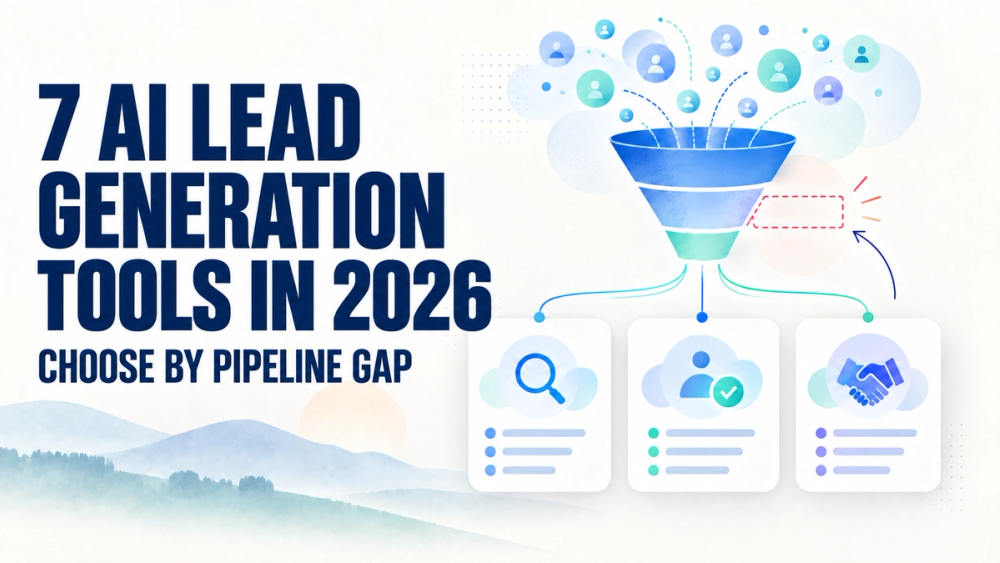
A sales team with too few suitable accounts has a different problem from a team that receives inquiries but responds late. Both may search for an AI lead generation tool. They should not buy the same product for the same reason.
Start with Apollo for an integrated prospecting workflow, Clay for configurable enrichment, or Cognism when contact coverage in your target market is the key question. LeadIQ fits prospect capture into a rep’s daily work. HubSpot keeps an inquiry attached to its customer history; 6sense addresses account prioritization; Qualified focuses on the inbound conversation and handoff.
This guide compares seven approaches to moving a prospect toward a qualified conversation. It does not treat a downloaded contact, an AI-generated email, and a sales-ready opportunity as equivalent results.
Identify the stage that is failing
| Tool | Best starting problem | What to compare | Main limitation |
|---|---|---|---|
| Apollo | Finding prospects and organizing outreach together | Usable records in your target segment | A large list can still have weak fit |
| Clay | Research and enrichment require repeated manual assembly | Data quality and cost per usable account | The workflow needs clear rules and maintenance |
| Cognism | Contact coverage is weak in the territory you sell into | A representative account and role sample | Data access does not create buying intent |
| LeadIQ | Reps repeatedly copy prospect details into the CRM | Capture, duplicate handling, and field mapping | It does not replace market selection |
| HubSpot | Inquiries lose their history or owner | Routing and follow-up in the customer record | It needs a consistent CRM process |
| 6sense | Too many target accounts compete for attention | Account signals that lead to useful action | A signal is not a confirmed buying request |
| Qualified | Website interest fails to become a useful sales handoff | Conversation, qualification, and meeting context | It depends on relevant inbound demand |
When finding the right accounts is the hard part
Apollo: a practical starting point for a small outbound team
Apollo makes sense for a founder or sales team that needs prospect data and a place to organize outreach without assembling a separate tool for every step. Its product navigation and plan documentation cover data, enrichment, integrations, and sales engagement. That breadth is the reason to shortlist it; a large contact count alone is not a buying argument.
Imagine a company selling software to regional distributors. The useful work starts by defining which distributors fit, who owns the relevant problem, and what evidence suggests a conversation would be timely. Apollo can support the research-to-outreach process, but those decisions still need an owner. Sending more messages to a loosely defined audience will not repair the targeting.
Its advantage over a purely custom research service is that the sales team can work in a repeatable environment. The trade-off is that database coverage and field quality must be evaluated against the actual niche. Sample records from the regions and roles you sell to, rather than judging the product from a familiar large-company example.
Apollo's pricing page describes free access, trial credits, and paid or custom arrangements. It also distinguishes account and credit systems. Check the allowances for the actions you will use, including data access and export, instead of assuming every visible record is included without conditions. We have not carried forward a single dollar price from the old article because the retrieved plan page did not provide a clear current rate for each tier.
For a useful trial, choose a small account set you understand. Record missing contacts, incorrect roles, duplicates, and the work required before a rep can act. Then evaluate the outreach workflow. This keeps the buying decision tied to usable prospects, not the ease of adding names to a list.
Clay: connect enrichment to a repeatable account-research process
Clay is useful when the team already knows the kind of account it wants but spends too much time assembling the evidence. A revenue-operations specialist might need to combine company attributes, recent signals, and contact information before deciding which records deserve a seller's attention. That is a different job from buying the largest possible list.
The current plans distinguish data credits from actions and include multi-provider enrichment and research workflows. Treat those as separate budget inputs. An enrichment waterfall can help the team look beyond one provider, but additional attempts and workflow steps still need to be measured. Availability of CRM synchronization and other integrations also depends on the selected tier.
Its advantage is control over the preparation process. You can define the question that must be answered before a record moves forward. Its weakness is the same requirement: an unclear targeting rule becomes a repeatable source of noise. Clay does not make an unsupported buying-intent inference reliable simply because the surrounding research is automated.
For example, start with a small account set and require an evidence link for a specific expansion signal. Review missing and conflicting information before writing anything to the CRM. Count records that meet the agreed definition, not populated cells. Compare Clay with Apollo when the main question is integrated prospecting convenience versus a more configurable enrichment process. LeadIQ deserves a separate look when a rep mainly needs to capture a prospect into the existing CRM.
Budget for the actual sequence of actions, data purchases, and human review. A short pilot should reveal whether the extra preparation improves the usable account list enough to justify maintaining the workflow.
Cognism: check the market you sell into, not the size of the database
Cognism belongs in the evaluation when a B2B team’s constraint is finding usable contact information for a defined territory. Its focus on European prospecting and phone data provides a concrete point of comparison. That is a reason to request a representative sample, not a reason to assume every record in every country is accurate.
Take a list of companies you genuinely want to reach, including smaller firms and less common job titles. Ask which contacts are current, which numbers have a stated verification process, and what information is available about the underlying record. A database can look impressive in a demonstration built around large, well-covered accounts and still miss the market you need.
The advantage is a clearer buying question than “Which AI finds the most leads?” You can evaluate coverage, freshness, and how much manual research remains. The trade-off is that better contact access does not supply the right offer, prove purchase intent, or organize the entire selling process. If the main problem is sequencing and follow-up, compare the combined stack with Apollo’s broader workflow.
Treat price as a proposal for your team’s actual access requirements. Clarify seats, export rights, usage allowances, integrations, and renewal terms. A vendor’s description of its data practices also does not determine whether your particular outreach campaign is appropriate; the team still needs a defined contact policy. Cognism makes the most sense when the value of the reachable target accounts can justify a dedicated data purchase.
LeadIQ: shorten the gap between finding a prospect and recording it properly
A rep who already knows where to look may not need another large research project. They may need to capture a relevant person, enrich the record, and put it into the sales system without repeatedly copying fields. LeadIQ brings contact capture, enrichment, and AI-assisted messaging into this workflow.
Its appeal is continuity. While reviewing a prospect, the rep should be able to preserve the company, role, contact details, and useful context in the place where follow-up actually happens. That is a narrower requirement than Clay’s configurable research process and different from 6sense’s account-level prioritization.
For a trial, use one new prospect, one existing CRM contact, and someone who has changed jobs. Inspect what gets created, what gets updated, and whether ownership stays correct. A duplicate with a newly generated email draft creates more cleanup, not a better lead. Also check whether the rep can review the proposed update before it changes a shared record.
The limitation is scope: convenient capture does not decide which market to pursue or which accounts deserve attention. Budget for the capture and enrichment allowances you need, the number of users, and the required CRM connection. Choose this route when reducing rep-side entry work is the measurable bottleneck; choose a broader sourcing or research platform when the team does not yet have a relevant prospect set.
When leads exist but the team cannot act consistently
HubSpot Sales Hub: keep the inquiry attached to its history
HubSpot is worth considering when marketing generates activity but sales lacks a dependable view of the person behind it. The company may already have forms, campaigns, and a CRM; the bottleneck is preserving context and assigning the next action.
Its Breeze offering sits within the customer platform, making it relevant to teams that want AI assistance around an established record. The buying case is strongest when HubSpot already holds the useful history or is the intended system of record. It is weaker if the company intends to leave most of its working information in disconnected tools.
Consider two inquiries with identical job titles. One has requested a demonstration and named a deployment deadline; the other downloaded a broad introductory document. Treating them identically wastes the context already available. During evaluation, examine how your configuration captures the distinction and gets it to the person responsible for follow-up.
HubSpot's breadth also creates a cost boundary. The required Sales Hub edition, adjacent Hub features, seats, and usage-based credits must be considered together. A free CRM entry point does not imply that every prospecting or automation feature is free. Ask for a breakdown tied to the workflow you demonstrated.
We would prioritize a small routing pilot over a large content-generation pilot. Check ownership, duplicate contacts, missing fields, and what happens when a rep is unavailable. HubSpot cannot decide your qualification policy for you, but a clear policy can make the surrounding tools much more useful.
6sense: prioritize accounts when sales and marketing can act together
6sense addresses a different stage from finding an email address. Its role is account intelligence and predictive prioritization: helping a team decide where to spend attention using signals about companies and buying groups. The most relevant buyer is a coordinated account-based sales and marketing team with a clear target market.
The potential advantage is deciding which accounts deserve additional research or a timely conversation. The important limitation is interpretation. Activity associated with an account is not the same as a named person asking to buy. Treat a signal as a reason to investigate, then compare it with the account history, fit, and anything the customer has actually said.
Before a pilot, agree on the action each type of signal should trigger. One might send an account to a rep for review; another might change which content marketing provides. If nobody owns the response, another dashboard will not repair the pipeline. A small team that mainly lacks contacts may get a clearer first result from Apollo or a targeted data purchase.
Request a scoped proposal covering data access, users, integrations, implementation, and ongoing administration. A generic annual price would obscure the services and implementation your team actually needs. Evaluate whether the resulting prioritization changes useful seller actions and accepted opportunities, rather than rewarding the system for producing more scores.
When interest and follow-up are separated
Qualified: for inbound demand that needs a reliable next step
Qualified adds an inbound-focused option for teams with valuable website traffic and a defined sales handoff. The relevant problem is a visitor showing interest while nobody is available to answer, qualify the inquiry, or arrange the next conversation. It is a weaker starting point when the company has not yet established a source of relevant visitors.
Its Piper plans cover website conversations, email engagement, meeting scheduling, routing, and CRM integrations. Pricing is customized rather than published as a simple per-seat figure. Ask for a proposal tied to the channels and volume you expect to use, including the integration and administration work required to make the handoff useful.
A reasonable trial follows a visitor with a concrete product question through to the seller's record. Check whether the answer stays within approved material, whether the meeting reaches the right owner, and whether an unresolved question remains visible. Also try someone who does not meet the qualification rules. A system that books every available visitor can increase meetings without improving the pipeline.
The advantage is connecting several inbound steps in one buying decision. The limitation is dependence on your traffic quality, qualification policy, and maintained product knowledge. Compare the complete handoff with your existing form, meeting scheduler, and CRM process. A fluent conversation is valuable only if it produces accurate context and an appropriate next step for the sales team.
Clean the record before spending another enrichment credit
Before expanding an AI workflow, inspect a small set of existing contacts for duplicates, stale roles, missing company links, and obsolete owners. Decide which record is authoritative and which lifecycle stages are still in use. Otherwise, enrichment can consume credits twice for one person, and a correctly generated alert can still reach someone who no longer owns the account.
Use a simple acceptance rule: the record must match the target market, contain enough verified context for the next action, and have a responsible owner. Keep “not enough information” as a valid outcome. Forcing every record into a positive score makes a dashboard look complete while hiding uncertainty.
Measure usable opportunities, not generated activity
Write the definition of a qualified lead before comparing tools. Include the customer profile, the evidence required, the intended next step, and the conditions that disqualify a record.
Then evaluate a small cohort through the full process:
- Sourcing: How many records actually match the profile after review?
- Preparation: What information must a rep correct or add before acting?
- Handoff: Does the next owner receive the original context and request?
- Engagement: Does the person respond to a relevant proposition?
- Outcome: Does the conversation reach the next stage your business defines?
Keep the denominators visible. Ten meetings from a highly filtered account set and ten meetings from a large unreviewed list describe different operating costs. Include staff review time, subscriptions, and data allowances when comparing them.
Outreach rules and the conditions for using contact data vary by channel and location; have the responsible team check the requirements for your actual program. A tool's availability is not permission to use every record in every way.
If the audience is already correct and the message is the weak point, the email writing guide addresses that narrower job. Product and billing references in this guide were checked on September 23, 2026. No conversion uplift or campaign result is implied by the illustrative scenarios.