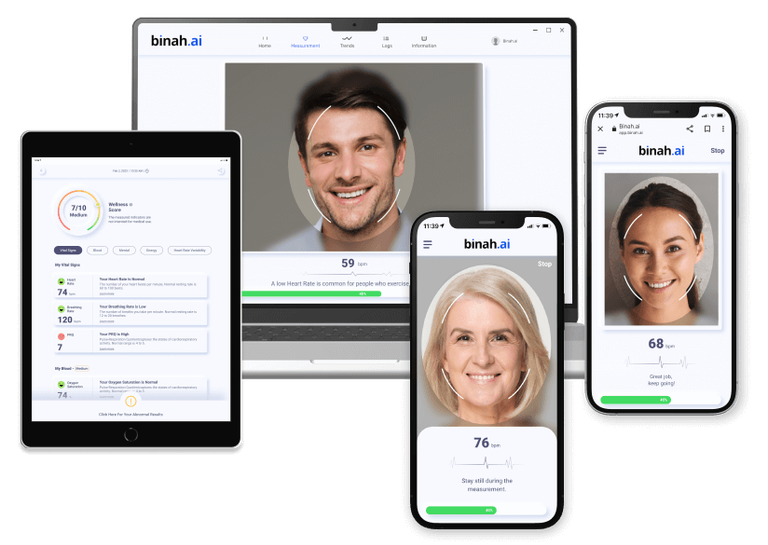
AI-powered health and wellness monitoring platform using video and PPG for vital signs, blood tests, and health risk detection.
Features
- Video-Based Vital Signs Monitoring — AI-powered technology that extracts and analyzes rPPG signals from exposed facial skin using smartphone or tablet cameras. Delivers comprehensive health measurements including blood pressure, heart rate, and oxygen saturation in just 35 seconds without any wearables or additional equipment.
- Bloodless Blood Tests — Groundbreaking capability to measure hemoglobin and hemoglobin A1C levels using only a smartphone camera. Also detects high fasting glucose, high total cholesterol, and low hemoglobin, providing laboratory-like insights without invasive blood draws.
- Advanced Cardiovascular Insights — Measures cardiac workload, pulse pressure, mean arterial pressure, and estimates 10-year ASCVD (Atherosclerotic Cardiovascular Disease) risk. Provides deeper analysis of heart strain, arterial health, and circulatory efficiency for proactive health management.
- Edge Architecture with Complete Privacy — 100% software-based solution that runs entirely on the end user's device with no cloud dependency or internet requirement. GDPR-compliant design ensures Binah.ai has zero access to end-user data, eliminating privacy concerns while maintaining stable performance.
- SDK-Based Integration Platform — Delivered as a Software Development Kit (SDK) for seamless integration into existing applications and workflows. Supports both spot checks via cameras and continuous monitoring through PPG sensors via Bluetooth, with 24/7 documentation and customer success support.
- Comprehensive Health Risk Detection — Goes beyond basic vital signs to detect chronic disease risks, stress levels, and wellness indicators. Includes heart age estimation and wellness scoring, providing a holistic health overview suitable for insurance underwriting, clinical triage, and preventive care programs.
Use Cases
Insurance Underwriting and Risk Assessment
Enables insurance companies to streamline underwriting processes with real-time health data from policy applicants. Supports dynamic underwriting, claims processing automation, policy renewal assessments, and straight-through processing (STP) triage. Reduces questionnaire burden by 15% while improving risk accuracy and client engagement by 66%. Target Audience: Life and health insurance companies, underwriters, and insurance technology providers seeking to modernize risk assessment and improve operational efficiency.
Remote Patient Monitoring and Telehealth
Provides healthcare providers with instant, real-time vital signs data during virtual consultations and ongoing remote monitoring. Supports patient triage (reducing triage time by 20%), elderly care, medication adherence tracking, and population health management. Eliminates the need for patients to own specialized medical devices. Target Audience: Hospitals, telehealth platforms, home healthcare agencies, and clinical research organizations conducting virtual trials or managing chronic disease populations.
Corporate and Consumer Wellness Programs
Powers engaging wellness initiatives for employers and wellness platforms by enabling easy health checks via smartphone cameras. Supports corporate wellness, mental wellness, travel wellness, and consumer wellness programs with personalized goal setting (35% increase) and measurable engagement outcomes (66% engagement, 55% satisfaction improvement). Target Audience: Corporate HR departments, employee wellness platforms, digital health apps, and travel insurance companies looking to offer value-added wellness services to their users.
Smart Device and IoT Health Integration
Enables consumer electronics and smart home manufacturers to embed health monitoring capabilities into their products. As demonstrated by partnerships with companies like Haier for smart appliances and Polar for fitness devices, Binah SDK transforms everyday devices into health monitoring tools. Target Audience: Consumer electronics manufacturers, IoT device companies, fitness wearable brands, and smart home appliance makers seeking to differentiate products with health monitoring features.
Pros
- 100% software-based solution requiring no dedicated hardware—leverages devices users already own (smartphones, tablets, laptops), significantly reducing deployment costs and barriers to adoption.
- Unique edge architecture operates entirely on-device with no cloud dependency or internet requirement, ensuring consistent performance, zero cloud costs, and complete data privacy compliance.
- Rigorously validated technology backed by a multidisciplinary team of PhDs in medicine, physics, and engineering, with third-party studies involving tens of thousands of subjects and ISO 13485:2016 certification.
- Comprehensive health insights in just 35 seconds covering vital signs, blood tests, stress levels, chronic disease risks, and cardiovascular assessments—far exceeding typical health monitoring solutions.
- Proven scalability with millions of users across insurance, healthcare, and wellness industries, supported by flexible business models and 24/7 integration support for enterprise customers.
Cons
- Not yet FDA-approved as a medical device (currently pursuing SaaMD classification), which may limit adoption in clinical settings requiring certified medical-grade equipment.
- Video-based measurements require adequate lighting and exposed facial skin, potentially limiting accuracy or usability in certain environments or for users with facial coverings.
- Accuracy may vary compared to traditional clinical-grade medical devices, as the technology relies on AI algorithms interpreting optical signals rather than direct physiological measurements.
- Requires integration via SDK into existing applications, meaning end-users cannot directly access the technology without a partner application or Binah's own consumer-facing products.