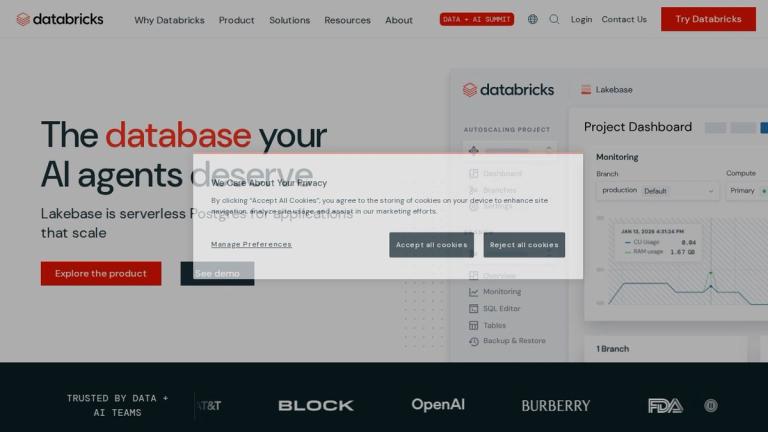
Databricks
Databricks is a leading data intelligence platform that enables organizations to build and run applications, AI agents, and machine learning models on their enterprise data. Founded by the creators of Apache Spark, Databricks provides a unified platform that combines data engineering, data science, and business analytics.
Core Platform
The Databricks Platform offers a comprehensive suite of tools for the modern data stack:
- Lakebase: Serverless Postgres database designed for AI agents and applications that need to scale
- Data Intelligence: AI-powered analytics that understand your data context
- Unified Governance: Enterprise-grade security and compliance controls
- Data Warehousing: High-performance SQL analytics
- Data Engineering: Scalable ETL/ELT pipelines
Key Highlights
- Trusted by Industry Leaders: Used by major enterprises including AT&T, OpenAI, Mercedes-Benz, Shell, Toyota, Siemens, and many more
- AI-Native Architecture: Built from the ground up to support AI workloads and agent-based applications
- Open Standards: Based on open-source technologies like Apache Spark, Delta Lake, and MLflow
- Cloud-Agnostic: Available on AWS, Azure, and Google Cloud Platform
Databricks acquired MosaicML in 2023 to strengthen its generative AI capabilities, enabling organizations to train and deploy custom large language models on their own data.
Target Audience
Enterprise data teams, data engineers, data scientists, ML engineers, and organizations looking to unify their data and AI strategy on a single platform.
Key Features
- Serverless Postgres database (Lakebase) for AI agents
- Unified data and AI platform
- Data warehousing and SQL analytics
- Data engineering and ETL pipelines
- Machine learning and model training
- Business intelligence dashboards
- Data governance and security
- Generative AI capabilities (MosaicML)
- Delta Lake for data reliability
- MLflow for ML lifecycle management
Use Cases
- Building AI-powered applications and agents
- Enterprise data warehousing and analytics
- Machine learning model development and deployment
- Real-time data processing and streaming
- Business intelligence and reporting
- Data lakehouse architecture
- Custom LLM training and fine-tuning
- ETL/ELT data pipeline orchestration
- Data governance and compliance management
- Collaborative data science workflows
Pros
- Unified platform eliminates data silos
- Scalable serverless architecture
- Strong enterprise security and governance
- Support for multiple cloud providers
- Active open-source community and contributions
- AI-native design for modern workloads
Cons
- Can be complex for small-scale projects
- Pricing may be high for smaller organizations
- Steep learning curve for advanced features
- Vendor lock-in concerns with proprietary features
Pricing
Usage-based pricing with consumption units; offers free tier (Community Edition) for learning; enterprise pricing available upon request with custom agreements for large deployments.