Quick picks
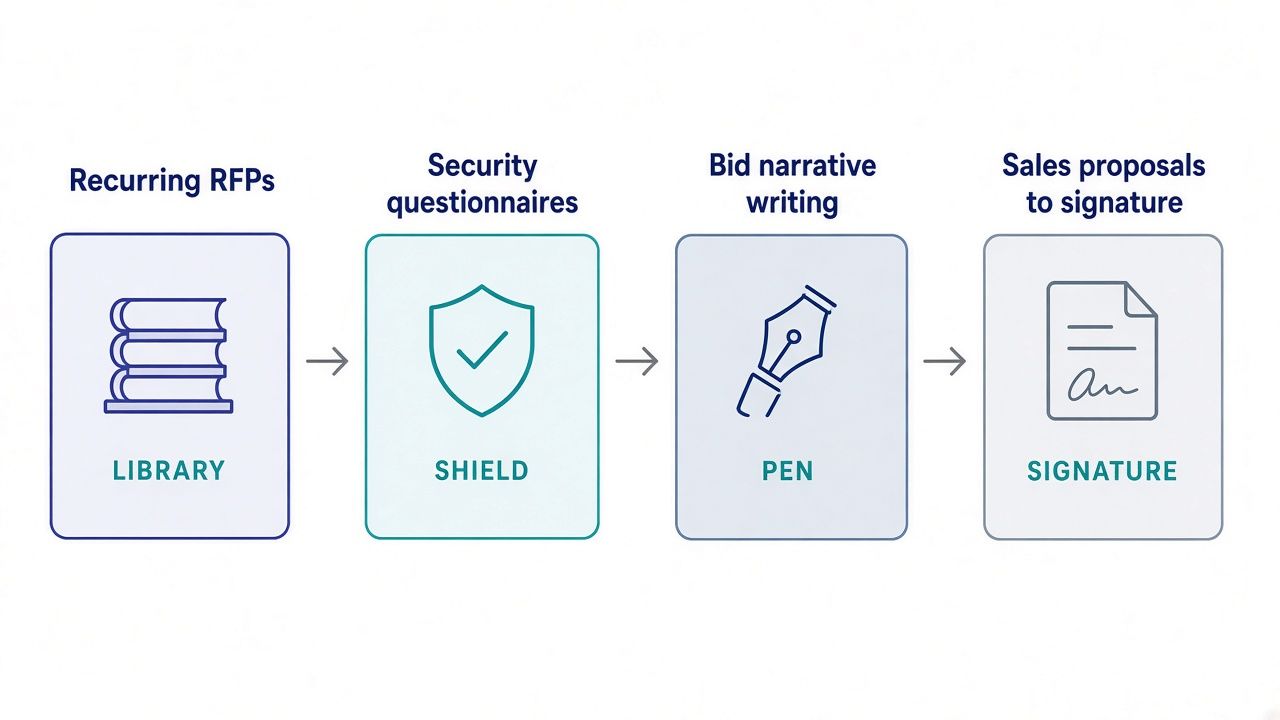
The best AI RFP software and AI proposal management tools depend on where work slows down. If buyers send you recurring RFPs, DDQs, or security questionnaires, start with Loopio or Responsive: both are built around response projects, reusable content, and coordination. Consider Inventive AI, AutoRFP.ai, Arphie, or Conveyor if you want an AI-first response workflow; compare their source handling, review controls, and commercial terms against your needs. If a long, evidence-heavy bid narrative is the bottleneck, evaluate AutogenAI. If you control the proposal format and need to move from a sales offer to approval or signature, consider PandaDoc, Proposify, or Qwilr. For industrial RFQ packages that need requirement extraction and deviation analysis, Loonar is a specialist option rather than a general-purpose answer library.
There is no universal winner. Compare the tools using an anonymized project, and check whether they fit your review process, source material, required output format, and budget.
- Recurring RFPs and questionnaires: Loopio or Responsive
- AI-first RFP answers and source review: Inventive AI, AutoRFP.ai, or Arphie
- Security questionnaires and customer trust workflows: Conveyor, Inventive AI, or an RFP platform that meets your process
- Long-form bid and grant narratives: AutogenAI
- Sales proposal, approval, and signature: PandaDoc, Proposify, or Qwilr
- Industrial RFQ requirement and deviation analysis: Loonar
What counts as AI proposal management software (and what doesn't)
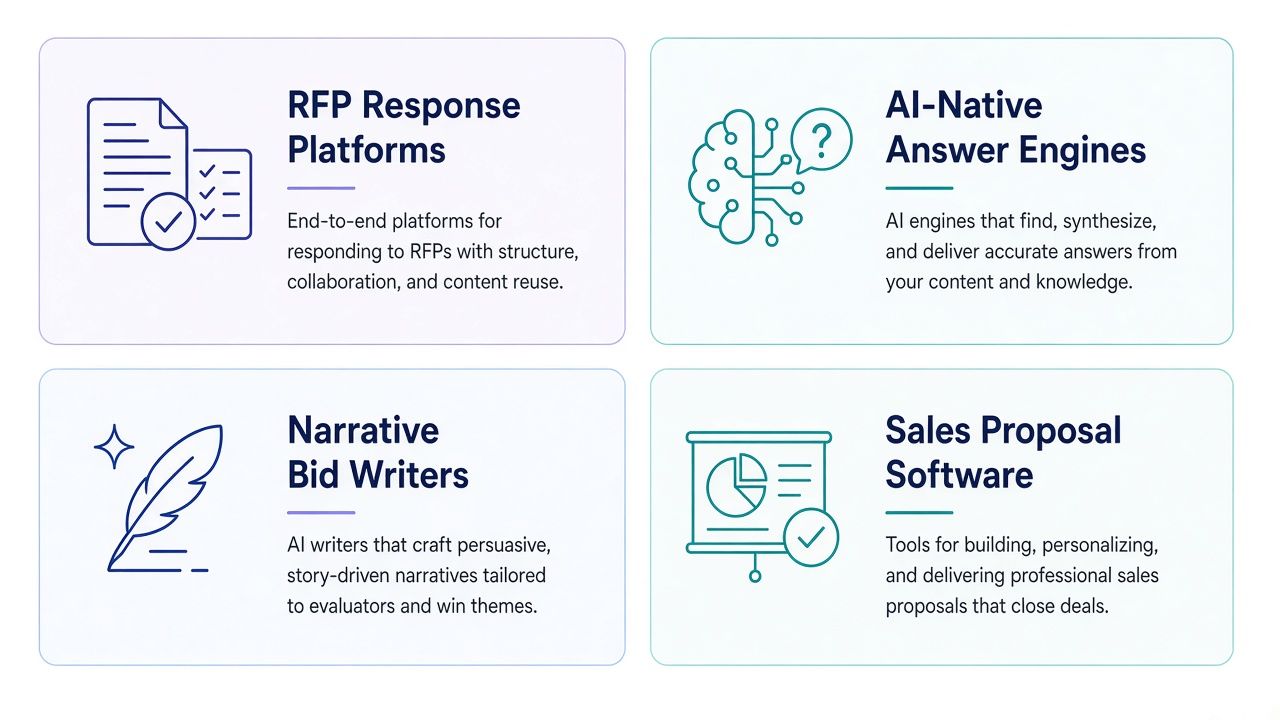
“Proposal software” can refer to several different products. They may all help produce a document, but they do not necessarily solve the same job. Before you compare features, identify what enters your workflow, who needs to contribute, and what the buyer expects to receive.
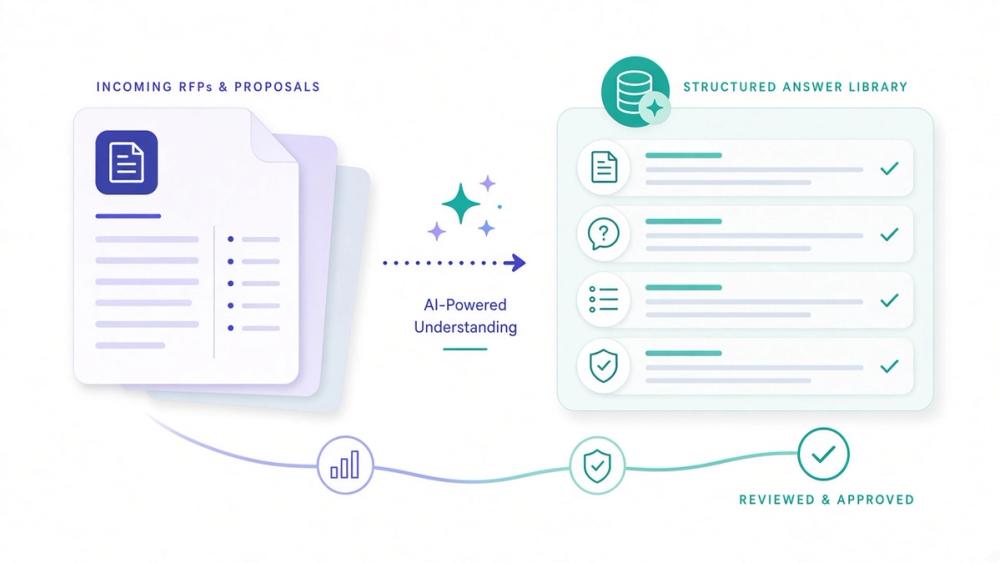
RFP response platforms organize structured responses to RFPs, RFIs, DDQs, and similar questionnaires. Their core work tends to include a reusable answer library, project management, assignments, review, and assembling responses into the requested format. Loopio and Responsive are examples of this category. The operational question is not only whether an answer can be drafted, but whether the organization can maintain, review, and reuse it responsibly.
AI-native answer engines put AI-assisted response generation closer to the center of the product. Inventive AI, AutoRFP.ai, Arphie, and Conveyor are relevant examples in this comparison. Their workflows may emphasize drawing from organizational content, showing source material, identifying missing information, or routing questions to people. Those are useful capabilities to evaluate, not guarantees that every answer is complete or safe to submit. You still need to check what a given product actually shows and how its review process works.
Narrative bid writers focus on developing longer proposals, bids, or grant submissions. AutogenAI belongs in this lane. A narrative writer may help you develop a coherent response around buyer requirements and your organization’s evidence. That is different from maintaining a large library of short, approved answers or completing a security questionnaire. A writing environment cannot supply evidence you do not have or approve commitments on your behalf.
Sales proposal and e-signature tools help you create a customer-facing offer and carry it through steps such as approval and signing. PandaDoc, Proposify, and Qwilr are examples. These products matter when you control the proposal format and want reusable sections, commercial content, or a buyer-facing document experience. They should not automatically be treated as substitutes for a structured RFP response operation.
Industrial RFQ analyzers handle a different kind of input: technical tender or RFQ packages that need requirements extracted, compared with an offer, or flagged as deviations. Loonar is in this specialist lane. It is not a general RFP answer library, and its job is not simply to fill in questionnaire fields from approved company content.
Finally, ChatGPT alone is not RFP software. A general-purpose assistant can help draft or revise text, but it does not by itself provide the complete operating environment described here: a maintained approved-answer library, project tracking, reviewer queues, organizational approval controls, or a proposal-to-signature workflow. Some RFP products mention connections to ChatGPT, Claude, or similar systems; those connections do not make the general-purpose assistant the system that governs your response process.
When you see “AI proposal management software” used as an umbrella term, ask which of these jobs the product actually supports. The distinction can save you from buying a polished writing interface when your real problem is stale content, slow SME review, or a required spreadsheet handoff.
Comparison table
The table is a starting point for shortlisting. Public entry points vary: some vendors show plans or starting figures; others require a quote. Confirm live pricing when a page was blocked, quote-only, or not self-serve.
| Tool | Best-fit job | Type | Free / public entry | SME routing & approvals | Main tradeoff | Source checked |
|---|---|---|---|---|---|---|
| Loopio | Recurring RFPs, DDQs, and security questionnaires | RFP response platform | Foundations, Enhanced, and Enterprise; custom quotes. Foundations is described as including 10 seats. | Library and SME coordination; Enhanced adds confidential projects and multi-step reviews. | Quote-based pricing and a library that needs ongoing ownership. | Loopio pricing · Nov 5, 2026 |
| Responsive | Cross-functional RFP response operations | RFP response platform | Emerging Edition starts from US$10,000; Growth and Enterprise; contact sales for Enterprise. | Project and team workflows; confirm the specific edition and approval controls in a demo. | Annual platform fee and a quote-based scope beyond the published entry. | Responsive pricing · Nov 5, 2026 |
| Inventive AI | AI-first RFP and security questionnaire responses | AI-native response platform | No public pricing page found; book a demo or request a quote. | SME tagging and review; evaluate queue and approval details directly. | Quote-based buying and a need to verify fit with your content and review model. | Inventive AI · Nov 5, 2026 |
| AutoRFP.ai | Repeated RFPs, DDQs, tenders, and questionnaires | AI-native response platform | Scale US$899/month billed yearly; Accelerate US$1,299/month billed yearly; Enterprise custom. | Confirm the review and assignment workflow in a demo. | Published pricing is project-limited by tier; check the definition and allowance for your volume. | AutoRFP.ai pricing · Nov 5, 2026 |
| Arphie | AI-assisted RFP and questionnaire work | AI-native response platform | Pricing page not publicly readable; request a quote. | Evaluate reviewer queues and approval controls directly. | Quote-based pricing and product claims that need validation against your governance needs. | Arphie · Nov 5, 2026 |
| Conveyor | Questionnaire automation and customer trust workflows | Security questionnaire and trust platform | Usage-based ConveyorAI pricing; Enterprise option; check current pricing. | Rules-based SME auto-assignment; confirm approval flow and plan scope. | Usage-based pricing requires you to understand expected consumption and scope. | Conveyor pricing · Nov 5, 2026 |
| AutogenAI | Bid, proposal, and grant writing | Narrative bid writer | No public self-serve pricing; request a quote. | Ask how contributors and reviews work for your bid process. | Not the same purchase as a reusable questionnaire library or sales e-signature platform. | AutogenAI · Nov 5, 2026 |
| PandaDoc | Sales documents through approval and e-signature | Sales proposal and document workflow | Free eSign is commonly listed; current paid prices need verification. Official pricing page was blocked on the check date. | Approval workflows and other capabilities depend on plan; verify the live plan. | Pricing and feature eligibility should be confirmed directly, particularly for AI and workflow needs. | PandaDoc pricing · Nov 5, 2026 |
| Proposify | Repeatable sales proposals and offer presentation | Sales proposal software | Build US$39/user/month annual or US$49 monthly; Grow US$65/user/month annual; Scale about US$107/user/month equivalent with a platform fee. | Approval workflows on higher tiers; check users, send limits, and overages. | Tier, platform-fee, send-limit, and add-on details can materially change cost. | Proposify pricing · Nov 5, 2026 |
| Qwilr | Interactive, web-based sales proposals | Sales proposal software | Starter US$35/user/month annual; Growth US$55 annual-only; Scale US$75 annual-only. Seat minimums apply to higher tiers. | Check the plan and process that provide the controls you need. | Annual terms, minimum seats on higher tiers, and document credits need review. | Qwilr pricing · Nov 5, 2026 |
How we ranked these tools (methodology)
This is a purchasing and workflow comparison, not a lab benchmark or a claim that one product produces more wins. We considered the jobs buyers are trying to complete and the product workflows described on official pages. The research method was official pricing and product pages checked on November 5, 2026, plus workflow analysis. We did not conduct hands-on testing across all products.
The comparison emphasizes six questions:
- Jobs to be done: Is the product designed for recurring RFP responses, security questionnaires, long-form bids, customer-facing sales proposals, or industrial RFQ analysis?
- Library and governance: Does the product offer an answer library or other way to organize reusable material? What should you ask about source ownership, freshness, and permissions?
- SME routing and approvals: Can the workflow bring in specialists and reviewers? Do not assume that a mention of collaboration means a specific approval process is available on every plan.
- Security-questionnaire fit: Does the product appear to target questionnaire automation or security and trust workflows? Verify the controls, integrations, and review steps that your organization requires.
- Pricing transparency: Can you see a public plan or starting point, or do you need a quote? Public prices are not a promise of your final contract cost.
- Sales-document lifecycle: If you control the format, does the product support the document and commercial workflow you need, including approvals, buyer interaction, or signing?
There are important limits. We make no win-rate claims and report no lab benchmarks. Prices and plan names can change after the date checked. Some pages were quote-only or not publicly readable, and PandaDoc’s official pricing page was blocked on the check date. For those products, confirm current pricing and plan details with the vendor. The table is intended to help you build a shortlist, not to replace procurement, security, or compliance review.
How to choose: six decision paths
Buyers send you RFPs, DDQs, or security questionnaires
Start with an RFP response platform if your work is repeated, structured, and depends on answers from multiple parts of the organization. A maintained library may help you find the latest approved material, while project workflows can help organize unanswered questions. Compare Loopio and Responsive for established response operations. Also compare the AI-native options if you want to evaluate how their drafting and source display fit your content.
Bring a representative questionnaire to a demo. Ask how a response is linked to its source, what happens when no suitable answer exists, and how a specialist can review a draft. If the work is mostly security questionnaires, compare the actual reviewer and trust workflows—not just the vendor’s AI language.
You control the proposal format
If you usually create an offer after a sales conversation, look at sales proposal software rather than beginning with an enterprise RFP platform. Your concerns may be reusable sections, customer and deal information, pricing tables, approvals, document presentation, and signatures. PandaDoc, Proposify, and Qwilr are the shortlist here, with different approaches to the customer-facing document.
First establish what the buyer will accept. If a prospect requires a particular attachment or spreadsheet, a web proposal may not be the right final deliverable even if its presentation looks appealing. If you can control the format, choose based on the complete path from drafting to buyer acceptance.
You need SME routing and approval workflows
Prioritize the route a question takes after a draft exists. Can a project owner identify an unanswered item, assign it to the relevant specialist, see whether the request is complete, and obtain the required approval before submission? Ask vendors to show those steps with your roles and sample content.
Loopio describes library and SME coordination, and its Enhanced plan adds multi-step reviews. Inventive AI describes SME tagging and review. Conveyor describes rules-based SME auto-assignment. Those signals can help you build a shortlist, but they do not tell you every detail of permissions, escalation, or plan eligibility. Verify the exact workflow before choosing.
Security questionnaires dominate your workload
Look at tools that explicitly target questionnaires and customer trust, including Conveyor, Inventive AI, AutoRFP.ai, Arphie, Loopio, and Responsive. Then decide whether your work is primarily answering standardized questions from a content base, managing trust materials, or coordinating a larger response operation. Those are related tasks, but they are not identical.
Ask what evidence the draft displays, how your team reviews sensitive claims, and which account or project controls are available. Vendor statements about security practices are not a substitute for your own compliance review. You should also confirm how the tool interacts with the sources you already use, such as the integrations a vendor lists.
Narrative or federal bids are the bottleneck
Consider AutogenAI if you need a dedicated environment for proposal, bid, or grant writing and the difficult work is developing a longer narrative. Ask the vendor to demonstrate how your evidence is used across a response, how your team works through a missing requirement, and how reviews fit your process.
AutogenAI states a FedRAMP High authorization on its homepage; verify that claim with your compliance team before treating it as settled. Compare AutogenAI on narrative development with your actual evidence, not a sample brochure.
Industrial RFQ deviation analysis is the job
If you receive technical tender packages and need structured requirements, page citations, deviation matching, terms-and-conditions analysis, or offer review, Loonar occupies a different lane from general AI RFP software. Choose around the work you must complete after analyzing the package, not around the broad word “proposal.”
Ask the vendor to process a representative package and show how it handles the requirements and deviations that matter to your team. No public price was found for Loonar, so request a quote. Industrial alternatives exist in this niche; see the dedicated section below rather than assuming a general questionnaire tool will perform the same analysis.
Enterprise RFP response platforms
Loopio
Who it's for: Teams that answer recurring RFPs, security questionnaires, and DDQs and want reusable content alongside project coordination. Loopio is a natural starting point if your organization has useful answers scattered across prior responses and people, but needs to make that material more findable and governable.
Standout features: Loopio describes a library and SME coordination, with AI and content capabilities. Its pricing page includes Foundations, Enhanced, and Enterprise. Foundations is described as including generative AI, unlimited projects, and 10 seats. The page also mentions connections to Claude, ChatGPT, and similar tools. Enhanced adds confidential projects and multi-step reviews.
A library is valuable only if someone owns its contents. During evaluation, ask how your team distinguishes current approved answers from older responses, how changes are maintained, and whether reviewers can see the context needed to make a decision. The fact that an answer once appeared in a submitted RFP does not mean it is still correct or appropriate for a different buyer.
Pricing notes: The official pricing page lists custom quotes rather than a public self-serve price. Request a quote and clarify the seat count, implementation, plan, and any features your approval process requires. Foundations is described as including 10 seats; do not assume that means the entry plan will fit your team or budget.
Pros: Loopio combines RFP, questionnaire, and DDQ work with a reusable library and SME coordination. The published plan information gives you useful questions to take to a vendor conversation, including whether multi-step reviews or confidential projects are necessary.
Cons: The price is quote-based, so it is harder to make a simple self-serve comparison. The platform also depends on your willingness to maintain the library. If your organization does not review and update shared content, reusable answers can spread old claims as easily as they can reduce repeated writing.
Workflow notes: In a demo, ask to find a current approved answer, assign a question to an SME, review the response, and update the library afterward. Include an answer you know has changed. The useful test is whether the workflow makes the change visible and supports the next response—not whether a clean sample project can be filled quickly.
Best if… Your team answers similar questionnaires repeatedly and wants a structured home for reusable content and coordination.
Skip if… You primarily need an interactive customer proposal and signature workflow, or you do not have a plan to govern the answer library.
For a closer look at the product, see Loopio. Check its official pricing page for current terms and request a quote.
Responsive
Who it's for: Organizations that coordinate recurring RFP work across functions and need a response operation that can span teams. Responsive, formerly RFPIO, positions its plans for different response volumes and levels of complexity.
Standout features: Its official pricing page describes Emerging, Growth, and Enterprise editions, an annual platform fee, unlimited projects and responses, and an AI and automation studio. The page frames Emerging as an option for low-to-moderate response volume or getting started, Growth for weekly volume, and Enterprise for complex, multi-team security and governance needs.
That positioning makes it useful to ask not only how the software drafts, but how it supports work across a large response team. In your demo, look at the path from project setup through assigning, reviewing, and preparing a final response. Ask how the plan you are considering supports the integrations, governance, and controls you actually need.
Pricing notes: Emerging Edition starts from US$10,000. Growth is listed without a public starting amount in the available pricing information, and Enterprise directs buyers to contact sales. Treat the displayed starting point as an entry into a commercial conversation, not as a full estimate. Request a quote that clarifies the annual platform fee, scope, and edition.
Pros: Responsive is a clear candidate if response projects are frequent and cross-functional. The pricing page gives buyers an explicit published Emerging starting point, while the named editions provide a useful structure for discussing scale and governance.
Cons: A public entry point does not show the complete cost or tell you which edition contains each required workflow. A broad platform can also be more than you need if you send only occasional proposals and do not manage a recurring questionnaire operation.
Workflow notes: Compare Responsive with Loopio using the work your team repeats: how specialists are engaged, how source content changes, how answers are reviewed, and how a final file is assembled. If you rely on complex spreadsheets, include a representative spreadsheet in the demo and ask the vendor to show the import and export path. Do not rely only on an AI-writing presentation.
Best if… You have an ongoing, cross-functional response operation and need to discuss a platform around project volume, integrations, and governance.
Skip if… Your main task is creating a polished, buyer-facing sales proposal after the deal scope is already agreed, or you need a simple public monthly price to purchase without sales involvement.
Check Responsive’s official pricing page for current terms and edition details.
AI-native RFP response and trust tools
Inventive AI
Who it's for: Teams evaluating an AI-first workflow for RFPs and security questionnaires, particularly where staff need to review AI-generated responses and source material rather than accept a draft blindly.
Standout features: Inventive AI describes a Knowledge Hub, answers grounded in approved content with citations, and flags missing information rather than guessing. Its product information also describes SME tagging and review, SOC 2, and integrations with SharePoint, Drive, Slack, and Salesforce.
These are product-posture descriptions, not a guarantee that a particular answer will be correct. Ask what a citation shows, how a reviewer checks whether the source supports the entire statement, and how the system handles contradictory or outdated material. A missing-information flag is useful only if the workflow helps someone resolve the gap.
Pricing notes: A public pricing page was not found; request a demo or quote. Ask for the quote to cover your expected response volume, users, integrations, and any implementation requirements.
Pros: The stated emphasis on a knowledge hub, citations, missing-information flags, and SME involvement speaks to the practical question of how generated answers can be reviewed. The listed integrations may be relevant if your source materials live in those systems.
Cons: Pricing is not public, and you will need a vendor conversation to confirm current packaging. Product descriptions do not establish the exact behavior of permissions, approvals, or source displays in your intended workflow.
Workflow notes: Bring an answer that has a clear approved source and another question that has no approved answer. Ask the vendor to show how each is handled. Then involve the SME who would own the second question and see whether the workflow helps them provide a grounded response without creating an unapproved commitment.
Best if… You want to evaluate AI-first questionnaire drafting with visible source material and explicit SME review.
Skip if… You need a public price to make a quick self-serve purchase, or you are looking for a dedicated industrial RFQ deviation analyzer rather than questionnaire response software.
Start with Inventive AI’s official site and request current pricing and workflow details.
AutoRFP.ai
Who it's for: Teams that want a published pricing structure for AI-assisted responses across RFPs, DDQs, tenders, and security questionnaires. Its pricing page defines a project as any RFP, DDQ, tender, or security questionnaire.
Standout features: The available plan details state that plans include unlimited users, all features, unlimited AI, implementation and support, and no paid add-ons. The plans differ in project allowances: Scale includes 24 projects per year, while Accelerate includes 50. Enterprise is custom.
That definition matters when estimating fit. Do not count only documents you casually call RFPs; check how your annual project volume maps to the vendor’s definition. A project-limited plan can be straightforward to compare, but only if your team and vendor use the same counting rules.
Pricing notes: Scale is US$899 per month billed yearly; Accelerate is US$1,299 per month billed yearly; Enterprise is custom. Confirm the current price, billing term, project allowance, and what happens when your use does not fit the published tier.
Pros: AutoRFP.ai has a more transparent public entry point than several quote-only AI response tools. The listed inclusion of users, features, AI, implementation, and support gives buyers specific items to verify rather than leaving every line open.
Cons: The published annual project allowances may not fit every response operation. “Unlimited” AI or users does not remove the need to understand the project limit, response review process, or how the answer source is presented.
Workflow notes: Ask the vendor to demonstrate a standard project, a question with incomplete evidence, and a revision after an SME correction. Check whether your existing content can be used and what the reviewer sees before submission. Evaluate the time and responsibility involved in maintaining the underlying answers as well as the drafting experience.
Best if… Your annual response volume fits a published project tier and you want a starting price to support budgeting.
Skip if… Your work is dominated by long, bespoke bid narratives, or your team needs a process that does not fit the plan’s project allowance without a custom arrangement.
See AutoRFP.ai’s official pricing page and confirm current terms before buying.
Arphie
Who it's for: Teams considering AI agents for RFPs and questionnaires that want source and confidence information available for review.
Standout features: Arphie describes AI agents for RFPs and questionnaires, source citations, and confidence information. Its official product information also mentions SOC 2 Type 2 and Zero Data Retention claims, as well as MCP. The vendor says switching usually takes less than a week with migration help.
Treat migration timing, security claims, and AI behavior as items to verify, not as a substitute for your own acceptance criteria. Ask what the vendor means by source citation and confidence, how a reviewer sees the evidence, and what your own migration would involve. A general vendor statement about typical switching time may not apply to your content structure or approval process.
Pricing notes: The pricing page was not publicly readable on the check date. Request a quote and confirm plan scope, implementation, data-handling terms, and the features included.
Pros: Source and confidence displays are relevant to teams that need to inspect a draft before submission. The vendor’s stated migration assistance may be worth discussing if you are considering moving an existing answer library.
Cons: Public pricing was not available, and you will need to validate the details of the listed product and security claims. A confidence indicator should not be mistaken for approval or proof that a claim is suitable for the buyer.
Workflow notes: Ask the vendor to show a response drawn from a source, then change or remove that source and observe how the draft and reviewer experience change. Ask how migration assistance works with your actual library, including its organization and content quality.
Best if… You want to assess source-aware AI assistance for RFP and questionnaire work and are prepared to request a quote.
Skip if… You need a publicly readable price or are choosing primarily for a sales-document and signature lifecycle.
Visit Arphie’s official site and request current pricing and security documentation.
Conveyor
Who it's for: Teams for whom security questionnaires, customer trust, and SME assignment are central to the workflow.
Standout features: Conveyor describes questionnaire automation and AI RFP responses, rules-based SME auto-assignment, and a Trust Center or customer trust platform position. Its ConveyorAI pricing is usage-based rather than per-user, and an Enterprise offering is listed.
The usage model is worth asking about early. A price that is not calculated per user may make a difference to organizations with many contributors, but it does not tell you what your usage will cost. Ask the vendor how the relevant usage is defined and what your team’s projected volume would mean under the plan being discussed.
Pricing notes: The official page describes usage-based pricing for ConveyorAI and an Enterprise option. Check current pricing directly and request a quote tied to your expected volume and workflow.
Pros: Rules-based SME auto-assignment directly addresses a common operational hurdle: getting questions to the right specialist. Its customer trust positioning may suit organizations that want questionnaire automation and a broader trust workflow in the same conversation.
Cons: Usage-based pricing requires a clear understanding of how consumption is measured. Do not assume that no per-user fee means a lower overall cost. Confirm the approvals and permissions included in your proposed plan rather than inferring them from auto-assignment.
Workflow notes: Bring examples of recurring security questions and ask the vendor to demonstrate how rules assign them. Include a question that should go to a particular team and one that has no clear owner. Then look at how the answer is reviewed, where its source is visible, and how your Trust Center workflow fits the submission.
Best if… Security questionnaires, trust information, and routing questions to SMEs are central to your response workload.
Skip if… You mainly need a long-form bid-writing environment, an interactive sales proposal, or pricing you can compare without understanding a usage model.
Check Conveyor’s official pricing page for current pricing and scope.
AI proposal writing for complex bids
AutogenAI
Who it's for: Teams developing substantial proposals, bids, or grant applications where the challenge is building a convincing, organized narrative from organizational material. AutogenAI lists Federal, Enterprise, and Grant Writer offerings.
Standout features: AutogenAI’s focus is proposal, bid, and grant writing. That makes it a different kind of shortlist candidate from a response library designed mainly to maintain short answers or a sales proposal tool designed around a customer-facing offer. Ask how the product helps you build a response around the specific requirements in a bid and the evidence your organization can support.
The vendor homepage states that it is FedRAMP High-authorized for the federal business-development lifecycle; verify current authorization with your compliance team. Do not treat that vendor homepage statement as an independent confirmation of current status or as approval for your organization to use the product. Your security and compliance teams need to confirm the requirements that apply to your work.
Pricing notes: No public self-serve pricing was available, and the pricing URL was not usable on the check date. Request a quote. Ask what the proposal covers, including users, source integration, implementation, and the offering that matches your use case.
Pros: A dedicated bid-writing focus can make it relevant when long-form narrative work, rather than questionnaire administration, is the main bottleneck. The named Federal, Enterprise, and Grant Writer offerings give you a starting point for discussing the right product scope.
Cons: There is no public self-serve price to use for a quick comparison. A narrative writer does not replace evidence, subject-matter judgment, or sign-off. If you need structured questionnaire assignments or a reusable answer library, compare the workflow directly with Loopio, Responsive, or the AI-native response tools.
Workflow notes: Use a demanding section from an anonymized past bid. Supply the evidence that supports the answer, then ask what happens when a requirement changes or the evidence is missing. Inspect whether the revised draft stays tied to the material your team can substantiate. Ask how the right people review and approve the final narrative.
Best if… Your difficult work is creating a longer bid or grant narrative and you want to evaluate a dedicated writing environment.
Skip if… You primarily need a proposal-to-signature process, a general security questionnaire workflow, or a public self-serve plan.
Review AutogenAI’s official site and confirm current pricing and compliance information with the vendor and your own teams.
Sales proposal software with AI assist
PandaDoc
Who it's for: Sales teams that want to create a customer-facing document and manage parts of its approval and e-signature lifecycle within a document workflow.
Standout features: PandaDoc’s AI Assistant is documented as available on Starter, Business, and Enterprise. Its broader product is commonly considered for proposals and document workflows, but confirm which content library, CRM, approval, and other capabilities are included in the specific plan you are buying. Do not infer that every feature appears at the lowest price.
The key distinction is that PandaDoc is aimed at documents and agreements, not at replacing an enterprise RFP response operation by default. If your normal process begins with a qualified opportunity and agreed scope, assess how a sales document moves from draft to approval and signing. If the buyer sends a large questionnaire, also evaluate dedicated response platforms.
Pricing notes: PandaDoc’s official pricing page was blocked by a security checkpoint on November 5, 2026. Commonly published figures list Free eSign, Starter around US$19 per seat per month on annual billing, Business around US$49 per seat per month on annual billing, and Enterprise custom; verify all prices and terms live. Monthly list prices may be higher. Treat these figures as a starting point for checking, not a confirmed current quote.
Pros: It is a relevant option when the commercial document lifecycle includes more than writing, and the AI Assistant is documented for multiple paid plans. The familiar plan structure can give you a straightforward set of questions to take to the vendor about seats and workflow features.
Cons: Current official pricing could not be verified on the check date. You should check plan eligibility for the features you need, including approvals, integrations, AI, and any advanced document workflow. A free e-sign option is not evidence that a full proposal workflow is free.
Workflow notes: Ask the vendor to use your deal fields, pricing structure, approval requirements, and signing process in a demo. Change a commercial detail after the first draft and see whether the document remains consistent. Ask how an approver reviews the proposal and how the signed document fits into the rest of your process.
Best if… You need a sales-document workflow that can carry an offer through review and signature.
Skip if… Your main use case is managing recurring RFP answers, or you cannot verify that the live plan includes the document and approval features you require.
Check PandaDoc’s official pricing page and AI Assistant documentation for current eligibility, pricing, and plan terms.
Proposify
Who it's for: Sales teams that send repeatable proposals but want the content and presentation to reflect each opportunity. It is particularly relevant when you control the format and need to coordinate templates, commercial sections, and approvals.
Standout features: Proposify describes AI writing and MCP. Its product is oriented around sales proposals, with approval workflows on higher tiers. That makes plan selection important: a team seeking governance should verify which tier offers the approvals, roles, and other controls it needs.
Reusable content can support consistency, but a proposal still has to represent the agreed deal. During an evaluation, check how the sales team can tailor a section without changing standard terms, pricing, or exclusions. Treat AI assistance as a drafting aid that requires review, not as authority to alter the offer.
Pricing notes: Build is US$39 per user per month billed annually, or US$49 monthly. The page also presents the annual Build amount as US$468 per user per year with “3 months free” messaging. Grow is US$65 per user per month annually; extra users are listed at US$780 per year. Scale is about US$107 per user per month equivalent, with a US$12,800 annual platform fee including 10 users; extra users are listed at US$780 per year. The page lists monthly send limits with overages. Confirm current limits, the treatment of extra users, and your complete annual cost directly.
The Build plan has a 14-day trial. Custom template design is listed at US$1,500, and a Launch kit at US$2,000. Verify whether these services are relevant to your intended setup and whether the prices still apply.
Pros: The published pricing gives buyers more detail than a quote-only page, including multiple tiers and some associated services. AI writing and higher-tier approval workflows are relevant if your team needs to create consistent customer-facing proposals with governance.
Cons: Platform fees, seat calculations, send limits, overages, and optional services make the comparison more involved than looking at a single per-user amount. Check the full terms before treating the lowest tier as sufficient.
Workflow notes: In a demo, test a proposal with standard and opportunity-specific sections, a changed price, and a required approval. Ask how the resulting document is sent and how you can confirm which version the buyer received. If you send many proposals, ask for the relevant send limits and overage terms in writing.
Best if… You want a repeatable sales proposal workflow and the plan you choose supports your team’s approval needs.
Skip if… Your primary workload is answering structured RFPs or security questionnaires, or your proposal volume makes the plan’s send terms a poor fit.
See Proposify and its official pricing page for current terms.
Qwilr
Who it's for: Sales teams that want to present proposals as interactive web pages and use a buyer-facing experience as part of their commercial workflow.
Standout features: Qwilr offers interactive web proposals, an AI assistant, and MCP. AI Prefill is listed on Scale. The plan structure includes document credit bundles, so ask how those credits apply to your expected work. A web page can be a useful format when you control the presentation; it does not remove the need to follow a buyer’s required file or procurement process.
Pricing notes: Starter is US$35 per user per month billed annually or US$49 monthly, with a one-seat minimum. Growth is US$55 per user per month annual-only with a five-seat minimum. Scale is US$75 per user per month annual-only with a 10-seat minimum. Qwilr publishes a 14-day Starter trial and document credit bundles. Confirm current pricing, seat minimums, credit allowances, and any overages before committing.
Pros: The interactive web proposal format clearly distinguishes Qwilr from document-oriented proposal tools. Its listed AI assistant and MCP, and AI Prefill on Scale, give you specific plan details to verify during evaluation.
Cons: Annual-only terms and minimum seats for Growth and Scale can make a plan less suitable for a small team. Document credits need to be included in your cost estimate. An interactive page is not automatically a fit for a buyer that requires a fixed-format attachment.
Workflow notes: Ask the vendor to show the whole buyer journey: how the proposal is assembled, how scope and optional items are presented, and how the buyer responds. Then bring a procurement requirement for a fixed file or spreadsheet and confirm how the team would satisfy it. Check the plan that includes the AI features you expect to use.
Best if… Your team controls the proposal format and wants an interactive web presentation for its offers.
Skip if… Buyers require a fixed-format response as your normal workflow, or you need a general RFP library and SME review platform.
See Qwilr and its official pricing page for current terms.
SME routing, approvals, and trusted answers
A fluent draft is not the same as an approved answer. When you evaluate trusted AI RFP tools, inspect the controls around the text as closely as the text itself.
Start with source display. Can the reviewer see which approved content supports a proposed answer? Is the source specific enough to check, and can the reviewer identify whether it is current? A citation is a useful review aid, not proof that the answer is complete or that the source applies to the buyer’s question. Ask the vendor to show what happens when two sources disagree or the supporting material is missing.
Next, inspect reviewer queues. Can someone see which questions remain unresolved, who owns them, and whether an approval has been completed? Can an SME correct a draft without losing the context of the question? Verify that the workflow you need is included in the plan being quoted.
Ask about confidential projects and the way sensitive response work is handled. Loopio lists confidential projects on Enhanced; that is a plan detail to verify, not a general statement about every product’s controls. For any platform, involve security and compliance reviewers when the project content or buyer requirements make that appropriate.
Finally, look for failure handling. A system should make uncertainty, missing evidence, or unresolved questions visible enough for your process. If a polished answer contains an unsupported commitment, fluency can make it more dangerous by giving the team confidence it has not earned. Require human review for claims that carry contractual, security, or compliance significance.
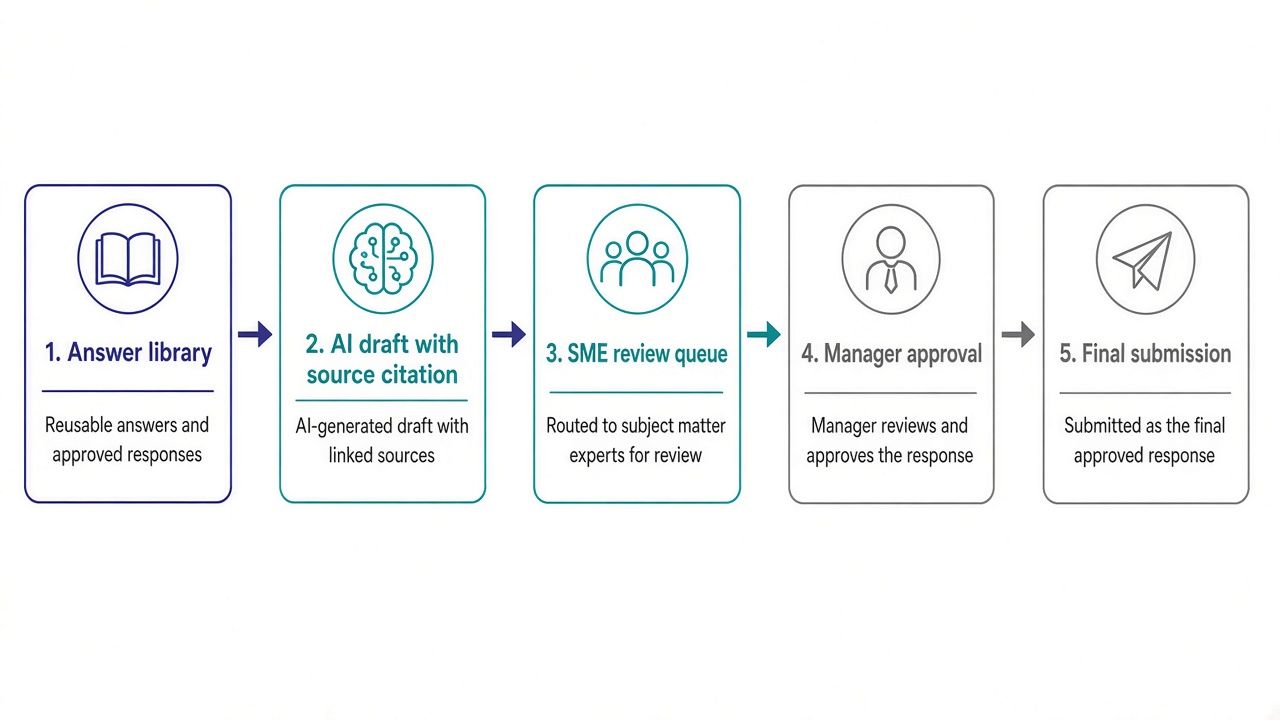
Industrial RFQ analysis vs RFP answer libraries
Industrial RFQ analysis is not just another name for questionnaire autofill. A manufacturer may receive a long RFQ or tender package that needs to be turned into structured requirements, cited back to pages in the source, compared with an offer, and reviewed for deviations or terms and conditions. That is a different workflow from retrieving an approved paragraph to answer a standard question.
Loonar AI is positioned for industrial manufacturers. Its described work includes taking an RFQ or tender package, extracting structured requirements with page citations, matching deviations, analyzing terms and conditions, and reviewing an offer. No public price was found, so request a quote. In a demo, use a representative package and ask the vendor to show the actual requirement and deviation outputs your team would rely on.
If what you need is a library of approved company answers and SME review, evaluate general RFP response platforms instead. If you need deviation lists for industrial RFQs, check vendors in that specialist niche. Alternatives discussed in that lane include ValveIQ, DRIMCO, Atira, OdysseyGPT, and standrdX. This is a list of products to investigate, not a price comparison or an endorsement; check those vendors directly for current capabilities and pricing.
What to put in a meaningful demo
A generic sample project will not tell you whether a product fits your process. Ask the vendor to work through an anonymized past RFP or proposal with difficulties your team has already encountered. You should be able to tell whether the output is useful because you understand the question, the source, and the required final format.
Include at least these scenarios:
- An anonymized past RFP: Choose a real project with normal structure and familiar requirements. Use it to see how the product handles your content, questions, and deliverable.
- A stale answer: Include material that you know is out of date. Ask how a reviewer can see its source and decide whether it should be used. Observe whether the workflow makes a stale answer easy to catch or merely makes it easy to reuse.
- A missing requirement: Include a question with no approved source. A useful demo should help you see what the product does when evidence is missing and how someone can take responsibility for resolving it. Do not treat a generated paragraph as an answer simply because it reads smoothly.
- A spreadsheet round-trip: If your buyers use a spreadsheet, bring an anonymized workbook. Ask the vendor to show what happens when it is populated and returned. Check whether the structure and the information your reviewers need survive the process.
- A scope change after drafting: For a sales proposal, change a scope item or commercial detail after the first draft. Check whether price, narrative, optional work, review, and final document stay aligned. For an RFP response, change a requirement or source and check how the proposed answer and review state change.
Ask the vendor to explain the workflow rather than narrate a prepared result. Who sees the draft? Where does the source appear? How is an unanswered question handled? What happens after an SME edits an answer? Which user approves the final response? If the product offers a customer-facing proposal, can you see the result the buyer receives?
Keep drafting speed separate from submission readiness. A fast first draft does not guarantee a fast review, a compliant response, or a successful deal. Your evaluation should identify where work is removed, where it moves to another person, and where you still need controls outside the software.
FAQ
What is the best AI RFP software in 2026?
The best AI RFP software in 2026 depends on whether you need an established response platform, AI-first drafting, or a specialist workflow. Compare Loopio and Responsive for recurring RFP operations, then consider Inventive AI, AutoRFP.ai, Arphie, or Conveyor if their source and routing workflows fit your needs. Use a representative RFP and check the comparison table above.
What is AI proposal management software?
AI proposal management software uses AI within a workflow for creating or managing RFP responses, bids, or customer-facing proposals. The term covers different product types, from response libraries and questionnaire tools to narrative bid writers and sales proposal platforms. Choose by the work you need to complete, not by the category label alone.
Are there trusted AI tools for generating RFP answers?
Yes, there are AI RFP response tools that describe source-grounded answers, citations, missing-information flags, or review workflows, but you should not treat any generated answer as approved without checking its evidence. Inventive AI describes approved-content grounding, citations, missing-information flags, and SME review; Arphie describes source citations and confidence information. Verify how these features work in your own demo, and keep human review for claims that matter.
What are Loonar RFQ alternatives?
Alternatives discussed in the industrial RFQ and deviation-analysis niche include ValveIQ, DRIMCO, Atira, OdysseyGPT, and standrdX. Check those vendors directly for current capabilities and pricing. They are not necessarily substitutes for a general RFP answer library, so compare them against the specific requirement-extraction, citation, terms, and deviation work you need.
Which RFP software has SME routing and approval workflows?
Loopio describes SME coordination, and its Enhanced plan adds multi-step reviews. Inventive AI describes SME tagging and review, while Conveyor describes rules-based SME auto-assignment. Confirm the approval sequence, permissions, and relevant plan with each vendor; a reference to routing or collaboration does not establish that every workflow is included in every tier.
What is the best security questionnaire automation tool?
There is no single best tool for every security questionnaire process. Compare Conveyor for questionnaire automation, rules-based SME assignment, and trust-center positioning; also assess Inventive AI, Loopio, Responsive, AutoRFP.ai, and Arphie if their response workflows fit. Evaluate source evidence, review steps, security requirements, integrations, and pricing together.
Can ChatGPT replace RFP software?
ChatGPT alone does not replace a full RFP response workflow. A general-purpose assistant can help draft text, but it does not by itself provide the organization’s maintained answer library, project tracking, reviewer queues, or approval process. Loopio’s pricing page mentions connections to Claude, ChatGPT, and similar tools; consider such connections as part of a platform workflow, not a reason to skip governance.
What is the cheapest AI proposal software?
There is no reliable universal answer because product types, billing terms, and feature requirements differ. AutoRFP.ai lists Scale at US$899 per month billed yearly; PandaDoc’s commonly published annual Starter figure is around US$19 per seat per month, but its official pricing page was blocked on the check date, so verify live pricing. Proposify Build and Qwilr Starter also have published starting prices, but may not provide the RFP or approval workflows you need.
Loopio vs Responsive for RFP teams?
Loopio describes a response library and SME coordination, with Foundations, Enhanced, and Enterprise available by custom quote; Foundations is described as including 10 seats. Responsive lists an Emerging starting point from US$10,000, Growth, and Enterprise, with an annual platform fee and unlimited projects and responses called out. Compare both using your real project workflow, content maintenance needs, required integrations, and approval process.
Do I need both RFP software and proposal software?
You need both only if you have both kinds of work and the tools do not cover them adequately in one workflow. An RFP platform is for structured buyer questionnaires and response operations; sales proposal software helps present an offer and can support steps such as approvals or signing. If your team only sends sales proposals or only completes RFPs, you may need just the product type that matches that job.
Final verdict
Use the comparison table to shortlist by workflow rather than by the breadth of an AI claim.
- For a team managing recurring RFPs and questionnaires: Start with Loopio and Responsive. Compare their libraries, project operations, required controls, and quoted costs using your own response process.
- For a team evaluating AI-first answer generation: Compare Inventive AI, AutoRFP.ai, Arphie, and Conveyor. Focus on source visibility, missing-answer handling, SME review, and how the plan is priced.
- For long-form bid or grant writing: Evaluate AutogenAI with a real, evidence-heavy section. Verify current pricing and, for federal work, verify authorization claims with your compliance team.
- For sales proposals you control: Compare PandaDoc, Proposify, and Qwilr based on document format, approvals, commercial workflow, and signing needs. Confirm live plan details before purchase.
- For industrial RFQ deviation work: Evaluate Loonar and other specialist vendors in that niche rather than assuming a general RFP answer tool will do the same job.
The right purchase is the one that removes the bottleneck without weakening your review process. A draft can save time and still require careful checking. Choose the workflow you can govern, price the plan you can actually use, and make the vendor demonstrate the difficult parts before you commit.
Related guides
- Compare tools for customer and sales data in our AI CRM comparison.
- Explore adjacent products in AI sales tools.
- See options for drafting and editing in AI writing tools.
- Compare software for creating files and business documents in AI document generators.
Prices and plan names checked November 5, 2026 against official pages where available. This is a purchasing and workflow analysis, not a claim of hands-on testing across all products or a promise of higher win rates.