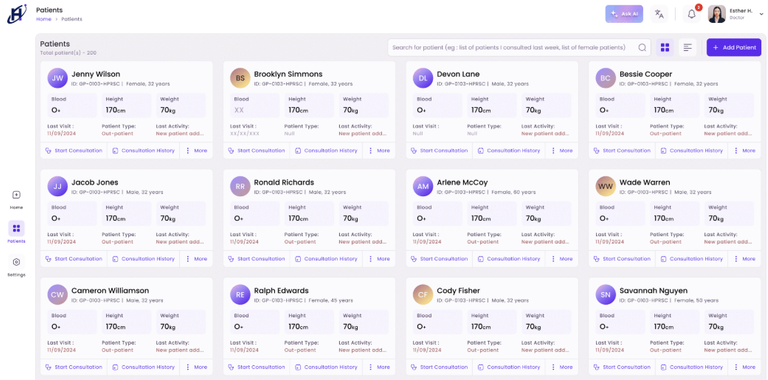
HealthOrbit AI is a clinical documentation and workflow platform that turns patient conversations into structured notes using ambient listening and voice commands—reducing admin time and helping clinicians stay focused on care.
Features
- Ambient AI Scribe — Listens to patient-doctor conversations in real-time during consultations and automatically generates structured clinical notes using advanced AI models that interpret complex medical terminology. Notes are seamlessly integrated into existing EHR systems, saving clinicians up to 90% of documentation time and recovering approximately 10 hours per week.
- AI Voice Assistant — Voice-powered healthcare AI that automates patient intake, scheduling, and triage workflows. Understands caller intent, books appointment slots, and sends automated reminders—reducing no-show visits by 20-30% and saving 10-20 minutes per consultation.
- AI Coding & Billing Automation — Extracts billable data directly from clinical notes, validates medical coding accuracy, and optimizes claims before submission. Includes specialized tools like Coding Validator to prevent logic errors and Claim Scrubber to stop rejections before reaching payers—recovering 5-20% of lost income and reducing claim denials by 30-40%.
- AI Language Interpreter — Provides real-time medical translation in over 65 languages, enabling clinicians to communicate effectively with diverse patient populations and breaking down language barriers in healthcare delivery.
- MDT Meeting Assistant — Transforms Multi-Disciplinary Team meetings by capturing, organizing, and documenting collaborative clinical discussions, ensuring all team contributions are accurately recorded and actionable follow-ups are tracked.
- Revenue Integrity Suite — Comprehensive revenue protection tools including Coding Validator for preventing logic errors and Claim Scrubber for eliminating rejections before payer submission—designed to safeguard healthcare organizations from revenue leakage and compliance issues.
Use Cases
Clinical Documentation for Busy Physicians
Doctors overwhelmed by administrative burden use HealthOrbit's Ambient AI Scribe to automatically convert patient conversations into structured EHR-ready notes. The system listens during consultations, processes medical terminology in real-time, and generates comprehensive documentation—allowing physicians to focus entirely on patient care rather than typing notes. Target Audience: Busy physicians, specialists, and clinicians spending excessive time on documentation instead of patient care
Patient Scheduling & No-Show Reduction for Growing Clinics
Clinics struggling with appointment management and high no-show rates deploy the AI Voice Assistant to handle incoming calls, understand patient needs, book appropriate slots, and send automated reminders. This streamlines front-desk operations while significantly reducing missed appointments and improving patient access. Target Audience: Growing medical clinics, outpatient facilities, and healthcare practices with overwhelmed front-desk staff
Revenue Cycle Optimization for Healthcare Organizations
Hospitals and health systems experiencing revenue leakage from under-coded services and claim rejections use the AI Coding & Billing platform to automatically extract billable data, validate coding accuracy, and scrub claims before submission—recovering lost income and reducing denial rates. Target Audience: Hospital administrators, revenue cycle managers, and healthcare CFOs seeking to optimize billing accuracy and reduce claim denials
Multilingual Patient Care in Diverse Communities
Healthcare providers serving linguistically diverse populations leverage the AI Language Interpreter for real-time medical translation across 65+ languages during consultations, ensuring accurate communication, informed consent, and quality care delivery regardless of language barriers. Target Audience: Healthcare facilities in multicultural regions, refugee health services, and international medical practices
Pros
- Dramatic time savings: Up to 90% reduction in documentation time with approximately 10 hours recovered per week per clinician, directly addressing physician burnout and administrative overload.
- Measurable revenue impact: Recovers 5-20% of income losses through automated coding and billing optimization, with 30-40% reduction in claim denials—delivering clear ROI for healthcare organizations.
- Comprehensive multilingual support: Real-time translation in 65+ languages enables equitable care delivery for diverse patient populations without requiring separate interpreter services.
- Seamless EHR integration: Designed to work with existing electronic health record systems, minimizing workflow disruption and reducing implementation barriers for healthcare organizations.
- Compliance-first architecture: Built with security and healthcare data protection at its core, adhering to the highest standards in healthcare compliance—critical for regulated healthcare environments.
Cons
- Privacy and consent considerations: Ambient listening technology that records patient-doctor conversations may raise patient privacy concerns and requires clear consent protocols and regulatory compliance across different jurisdictions.
- AI accuracy limitations: Automated clinical documentation and medical coding may struggle with highly complex, nuanced, or rare medical cases, requiring clinician review and verification to ensure accuracy.
- Implementation and adoption curve: Healthcare organizations may face challenges integrating AI tools into established clinical workflows, requiring staff training, change management, and potential workflow redesign.
- Dependency on technology infrastructure: Requires reliable internet connectivity and compatible EHR systems, which may limit adoption in resource-constrained settings or facilities with legacy technology systems.