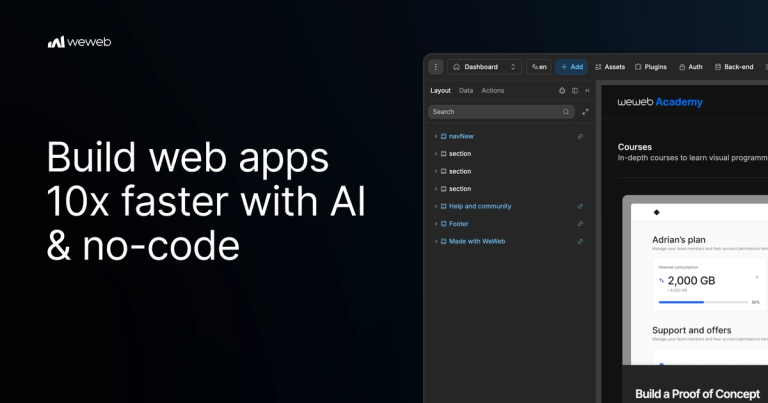
WeWeb is an AI-driven no-code platform for building production-ready web applications with speed, flexibility, and zero vendor lock-in.
Features
- AI-Powered App Generation — WeWeb's AI assistant can generate complete web applications from natural language descriptions, including full pages, databases, business logic, and coded components. Users simply describe their app idea in plain language, and the AI handles the technical implementation, dramatically accelerating the development process.
- Visual Drag-and-Drop Editor — A comprehensive visual editor that allows users to fine-tune every aspect of their application without writing code. From simple pixel-level design adjustments to complex workflows with conditional branching, the editor provides granular control over both UI and functionality.
- Code Export & Zero Vendor Lock-in — Unlike many no-code platforms, WeWeb allows users to export their applications as standard Vue.js Single Page Applications (SPAs). This enables self-hosting on-premise or deployment to any cloud provider, giving teams complete ownership of their code and infrastructure.
- Enterprise-Grade Security & Compliance — Built with enterprise requirements in mind, WeWeb supports SOC2, HIPAA, and GDPR compliance. The platform enables secure connections to internal databases without data replication, keeping sensitive information on your own servers while maintaining regulatory standards.
- Built-in Integrations Ecosystem — WeWeb comes with pre-built integrations for common services including email, SMS, external APIs, and popular databases like Airtable, Xano, and Supabase. The modular architecture connects to your preferred tech stack without compromising performance.
- Design Systems & Reusability — Leverage design systems to maintain visual consistency across projects and accelerate delivery. Create reusable components and templates that can be shared across multiple applications, ensuring brand consistency while reducing development time.
Use Cases
SaaS Product Development
Build and launch complete SaaS products from scratch using AI generation and visual editing. WeWeb supports the entire SaaS lifecycle from MVP prototyping to production-scale applications, with features like user authentication, subscription management, and multi-tenant architecture. The platform is trusted by startups and Fortune 500 companies alike for building scalable software businesses. Target Audience: Startup founders, SaaS entrepreneurs, and product teams looking to rapidly validate and launch software products without extensive engineering resources.
Internal Tools & Business Process Automation
Create custom internal tools for operations, logistics, supply chain management, compliance tracking, and employee portals. WeWeb's ability to connect securely to internal databases and maintain data sovereignty makes it ideal for organizations that need to build workflow automation tools while keeping sensitive data on their own infrastructure. Target Audience: Operations managers, IT departments, and enterprise teams in healthcare, logistics, finance, and other regulated industries who need custom internal applications.
Client Portals & Customer-Facing Applications
Build professional client portals, customer dashboards, and external-facing applications that integrate with existing backend systems. WeWeb's design system capabilities ensure brand consistency while its scalability handles growing user bases without per-user pricing, making it cost-effective for customer-facing products. Target Audience: Agencies, service businesses, and B2B companies that need to provide branded digital experiences to their clients and customers.
Rapid MVP Prototyping & Validation
Quickly transform business ideas into functional prototypes for user testing and investor presentations. The AI-powered generation combined with visual editing enables non-technical founders to build and iterate on minimum viable products in hours rather than weeks, accelerating the validation cycle. Target Audience: Non-technical entrepreneurs, innovation teams, and product managers who need to quickly validate business concepts before committing to full development.
Pros
- No coding experience required - AI handles technical implementation from natural language descriptions, making app development accessible to non-technical users and dramatically reducing time-to-market.
- True code ownership with Vue.js export capability - Unlike competitors that lock users into proprietary platforms, WeWeb allows full code export for self-hosting, providing long-term flexibility and eliminating vendor dependency.
- No per-user pricing model - WeWeb doesn't charge based on the number of application users, making it cost-effective for applications with large user bases and enabling businesses to scale without exponential cost increases.
- Enterprise-grade compliance built-in - Native support for SOC2, HIPAA, and GDPR compliance with secure database connections that don't require data replication, meeting the security requirements of regulated industries.
- Versatile integration ecosystem - Pre-built connections to popular databases (Airtable, Xano, Supabase), APIs, email, and SMS services reduce setup complexity and enable rapid connection to existing tech stacks.
Cons
- Web-only platform - WeWeb generates web applications (Vue.js SPAs) and doesn't natively support mobile app development, potentially requiring additional solutions for mobile-first use cases.
- AI-generated output may require refinement - While AI accelerates initial development, complex business logic and nuanced UI requirements may still need manual adjustment through the visual editor or custom code.
- Learning curve for advanced features - While basic app creation is accessible, mastering complex workflows, custom integrations, and design systems may require time investment and familiarity with web development concepts.
- Dependency on third-party backends - WeWeb is primarily a frontend builder and relies on external backend services (Xano, Supabase, etc.) for data management, which adds complexity and potential points of failure for full-stack applications.